
Inherent's Faraday AI Agent Beats Claude Opus 4.8 and GPT-5.5 at Scientific Paper Replication
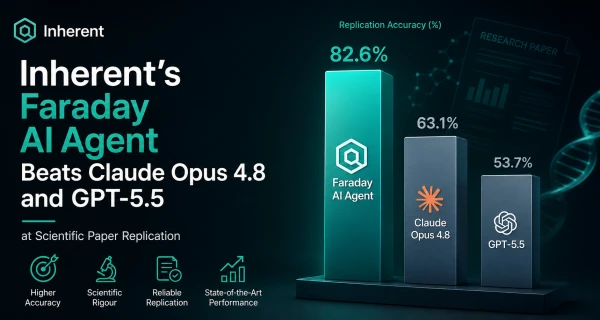
London-based AI laboratory Inherent has released Faraday, a 27-billion-parameter AI agent designed to act as a scientific collaborator, and claims it outperforms far larger frontier models from Anthropic and OpenAI on the demanding task of independently replicating published research papers.
The results, detailed in a technical paper and accompanying company research post, show Faraday achieving higher faithfulness scores than Anthropic’s Claude Opus 4.8 and OpenAI’s GPT-5.5 across a new benchmark called Replica.
Faraday is built on Alibaba’s Qwen 3.6 base model and uses larger coding agents as tools rather than attempting to perform every step itself.
Inherent, founded by former Google DeepMind researchers, emerged from stealth earlier this year with a $50 million seed round co-led by Index Ventures and Radical Ventures.
The company positions Faraday as an early step toward AI systems that can contribute original scientific insight rather than simply answering questions or generating code.
Paper replication is a standard training exercise for human PhD students. Researchers are often asked to reproduce a key figure or experimental result without being handed the final plot or the full set of intermediate failures that produced it.
Inherent formalized this process into Replica, a suite of 310 tasks drawn from 100 machine-learning and AI-for-science papers spanning natural language processing, materials science, structural biology, meta-learning and weather forecasting.
Each task requires an agent to reproduce a figure under limited time and compute budgets, without access to the original plot. Success is judged not only on visual similarity but on experimental depth, faithfulness to the paper’s claims, scientific integrity and effective use of resources.
Inherent developed a rubric-based automated judge validated against human expert rankings to make the evaluation consistent enough for reinforcement learning.
According to the company’s evaluations, Faraday outperforms Claude Opus 4.8 and GPT-5.5 on 73 percent of in-distribution machine-learning tasks and on 60 percent of held-out AI-for-science tasks.
On the test split it records an average improvement of roughly 6 percent over Claude and 8 percent over GPT-5.5. Human experts, when shown rollouts where the automated judge gave Faraday a clear edge, preferred Faraday’s approach in the large majority of cases.
The performance gap is attributed less to raw model scale than to post-training. Faraday was trained with long-horizon reinforcement learning that rewards research taste—the ability to design experiments that remain faithful to the original scientific claim even when compute must be scaled down, and to avoid shortcuts such as hard-coding outputs that merely look correct.
The agent treats coding models (initially GPT-5.4-mini, later GPT-5.5 Codex) as tools the way a human scientist uses existing software packages.
“We’re always guided by that north star of building an AI scientist agent and imbuing our agents with taste,” co-founder and chief scientist Edward Hughes told TechCrunch. Hughes previously worked on cooperative AI research at DeepMind alongside other Inherent founders.
Faraday also demonstrated generalization. A checkpoint trained only with the smaller coding agent improved its scores when the stronger GPT-5.5 Codex tool was substituted at evaluation time, without further training. On a smaller set of full-scale replications that allowed up to eight hours and multiple high-end GPUs, Faraday still edged Claude according to the same rubric.
The company emphasizes that replication is only a stepping stone. Research papers report what worked; they omit the many failed attempts that led to the final result. Successfully recovering that “99 percent perspiration” requires the same hypothesis-driven exploration needed for open-ended discovery.
Inherent is already experimenting with underspecified and counterfactual versions of the tasks that force the agent to innovate rather than merely reproduce.
Inherent operates as a small in-person team of about a dozen people in London’s King’s Cross neighborhood, an area that has become a significant AI hub partly because of DeepMind’s long presence there.
The company plans to grow to 20–25 employees by the end of 2026. It describes itself as building both a new kind of AI system and a new kind of research institution optimized for human–AI collaboration in science.
The results arrive at a moment when the AI industry is debating whether continued gains will come primarily from larger models or from more sophisticated agent architectures, scaffolding and specialized post-training.
Faraday’s approach—pairing a relatively compact model that has been carefully trained for scientific judgment with much larger general-purpose coding tools—offers one data point in favor of the latter strategy.
Whether Faraday or similar systems can move beyond replication to genuine scientific discovery remains an open question. Inherent’s published work, however, provides both a concrete benchmark and a training recipe that other labs can examine, criticize and build upon.
For researchers and engineers watching the rapid evolution of AI agents, the Faraday results underscore that “research taste” may be as important as parameter count when the goal is to accelerate science rather than simply generate plausible text.
Inherent has released the technical paper on arXiv and a detailed research summary on its website. The company continues to hire and is investigating how the same methods might contribute to scalable oversight and safer agent behavior.