
DeepMind Alumni Startup’s Tiny Faraday Agent Beats Claude Opus 4.8 and GPT-5.5 at Scientific Paper Replication
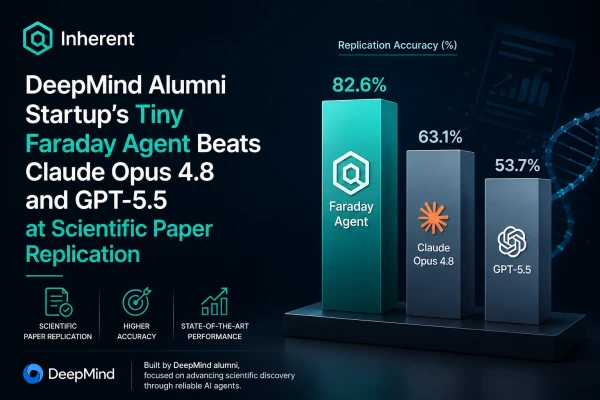
London-based AI lab Inherent, founded by Google DeepMind alumni, has released results showing its specialized agent Faraday outperformed much larger frontier systems from Anthropic and OpenAI on the demanding task of independently replicating published scientific research.
Faraday, built on a 27-billion-parameter Qwen 3.6 base model, achieved higher fidelity replications than Anthropic’s Claude Opus 4.8 and OpenAI’s GPT-5.5 across a new benchmark called Replica.
The agent scored wins on 73 percent of in-distribution machine-learning tasks and 60 percent of held-out AI-for-science tasks, according to the company and its accompanying technical paper.
The results, detailed in a TechCrunch report on August 22 and on Inherent’s research site, mark a notable demonstration that carefully trained scientific judgment can outweigh raw model scale for certain research workflows.
Inherent emerged from stealth only weeks earlier with a $50 million seed round led by Index Ventures and Radical Ventures. The company positions Faraday as an “AI Scientist” teammate rather than a fully autonomous researcher. Its longer-term goal is agents capable of contributing original scientific discovery across domains.
Paper replication was chosen as the near-term evaluation because it mirrors a common starting exercise for human PhD students. Research papers typically report successful results while omitting the many failed experiments and design choices that led there.
Successfully reconstructing a figure therefore requires hypothesis-driven exploration, experimental design skill, and what the team calls “research taste.”
Replica consists of 310 tasks drawn from 100 papers spanning natural language processing, materials science, structural biology, weather forecasting and other areas.
Agents must reproduce a figure without access to the original plot and under constrained time and compute budgets. Inherent developed an automated rubric-based judge that showed strong agreement with human experts and lower noise than a pure LLM judge, enabling reliable reinforcement-learning training.
Faraday was trained with long-horizon reinforcement learning, treating coding agents as tools. During training it primarily used a smaller OpenAI model; at test time it directed the more capable GPT-5.5 Codex.
The company reports that this layered approach improved performance and that Faraday can adapt to stronger coding tools as they appear. Unlike some earlier “AI Scientist” systems, Faraday does not rely on a hand-crafted evolutionary search harness or external test-time rewards; it learns to value productive experimental directions intrinsically.
Cofounder and chief scientist Edward Hughes told TechCrunch that beating the frontier agents was secondary to the method. “What was most interesting to us about this was not so much the result of beating those frontier agents — which of course we liked — but was actually the way we went about building this.” The team deliberately avoided building its own coding infrastructure, preferring to orchestrate existing tools the way human scientists do.
Inherent currently employs about a dozen people, all working in person from an office in London’s King’s Cross. The company plans to grow to 20–25 staff by year-end and is actively hiring.
Hughes has publicly criticized UK “garden leave” practices that delay researchers from joining new startups, arguing they put British labs at a disadvantage relative to the United States.
The Faraday results arrive amid intensifying interest in AI agents that can handle open-ended scientific work. While pure scale continues to drive progress on many benchmarks, Inherent’s findings suggest that targeted post-training for scientific rigor and taste can produce competitive or superior performance on research-adjacent tasks at far lower parameter counts.
Whether the same approach generalizes to genuine discovery — generating and validating novel hypotheses rather than reconstructing known results — remains an open and higher-stakes question. Inherent frames Faraday as an early step toward that capability and emphasizes keeping humans in the loop for oversight and safety.
For now, the demonstration that a comparatively small, purpose-trained agent can outpace the current largest closed models on a carefully designed scientific benchmark is likely to draw close attention from both researchers and investors watching the agentic AI landscape.