
Gates Foundation Commits $1 Billion to Equitable AI
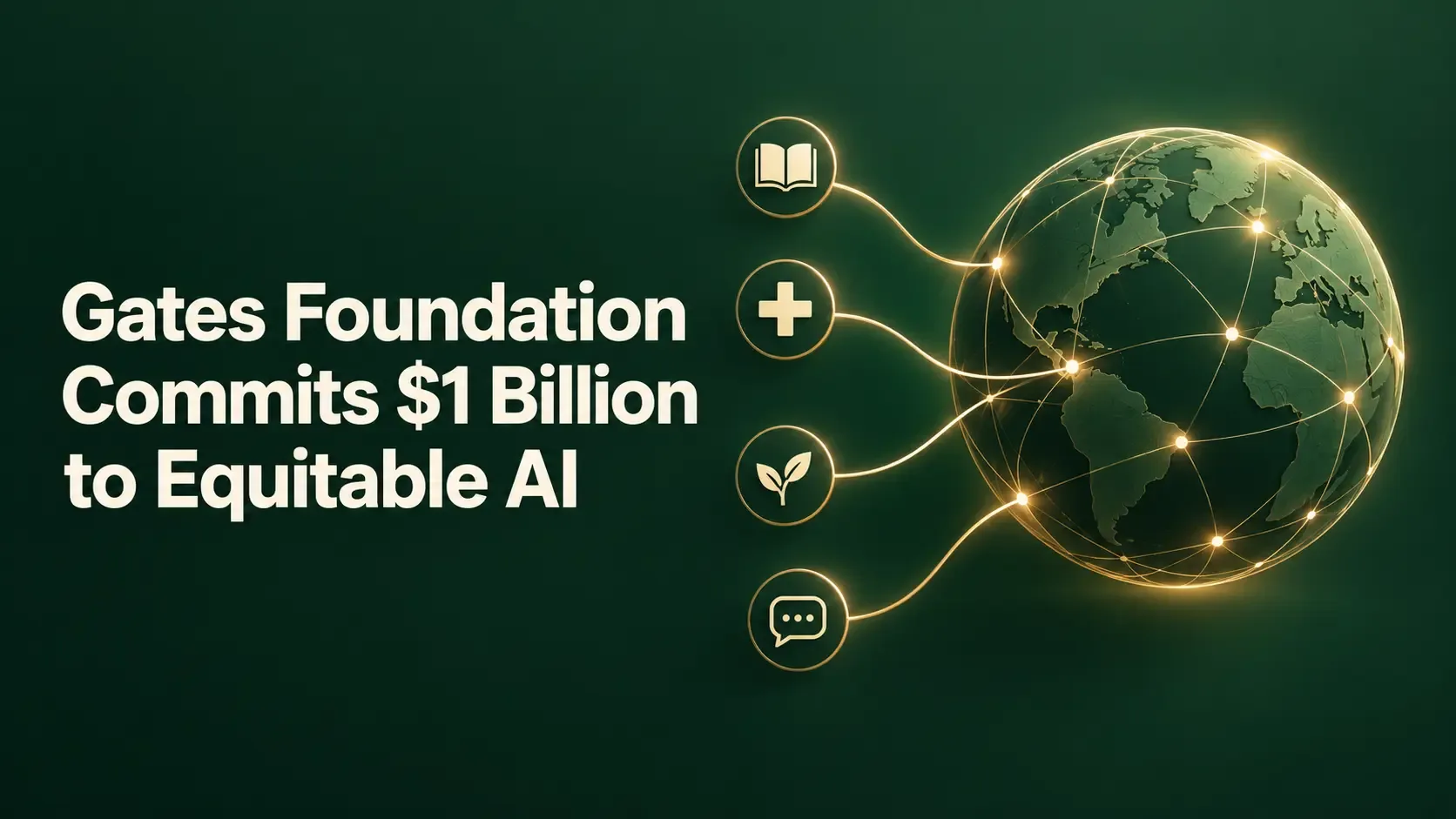
Gates Foundation $1 billion AI funding will support education, health care, agriculture and local-language data over the next two years, turning the philanthropy’s equity agenda into a defined spending program.
The September 14 commitment divides the money into four priorities:
- 40% for education tools and AI tutoring
- 40% for health care and medical research
- 10% for smallholder agriculture
- 10% for datasets and digital foundations
Gates Foundation’s $1 Billion AI Plan Sets a Two-Year Budget
The Gates Foundation said it will spend at least $1 billion to expand access to artificial intelligence and practical AI-enabled services. The commitment accompanies its 2026 Goalkeepers Report, which focuses on preventing new technology from widening gaps between wealthy and underserved communities.
The allocation supplies unusually specific targets for a large philanthropic AI program. Roughly $400 million is earmarked for education, another $400 million for health care, about $100 million for agriculture and the remaining $100 million for data and infrastructure that can support broader access.
The money forms part of the foundation’s previously announced plan to spend $9 billion annually. It is not a single grant to an AI company, and the foundation has not published a complete list of recipients. Funding will flow to multiple partners and programs during the two-year period.
Education and Health Receive 80% of the Commitment
Education and health together account for four-fifths of the planned spending. In classrooms, the foundation expects to support AI tutoring that adapts to individual students and tools that help teachers identify misunderstood concepts, rework lesson plans and provide more focused assistance.
The education portfolio spans U.S. classrooms and lower-resource settings abroad. Its effectiveness will depend on curriculum alignment, teacher oversight, student privacy and evidence that automated guidance improves learning rather than simply increasing screen time or producing more polished assignments.
Health programs will cover diagnostic support, clinical decision tools for frontline workers, maternal and newborn care, and research for new medicines and vaccines. The Associated Press cited an example in which software double-checks clinical reports for symptoms that may have been overlooked.
Those uses operate in high-stakes environments where local validation is essential. A model that performs well on records from a well-resourced hospital may fail when terminology, available tests, disease patterns or clinical workflows change. Human review and country-specific evidence will determine whether the tools are safe enough to scale.
Local Languages and Farm Data Address AI’s Coverage Gaps
The foundation says more than 90% of the data used to train early large language models came from English-language sources. Its response is a dedicated 10% allocation for datasets in languages that leading AI systems do not yet understand well.
Better language coverage involves more than translation. Useful systems must understand local names, institutions, crops, health terminology and cultural context, while communities need control over how their data is collected, protected and reused. The program therefore combines model access with investment in the underlying information.
A separate $100 million agriculture allocation will target advice tailored to a farmer’s soil, weather and crop conditions. Potential applications include planting decisions, pest control, fertilizer use, livestock care and market information delivered through affordable tools in locally relevant languages.
Accuracy and access remain linked. Real-time advice is valuable only when it reflects reliable local observations and reaches farmers through devices and networks they can use. The program will need to measure whether recommendations improve yields or resilience, not merely how many people open an application.
OpenAI, Anthropic, Google and Microsoft Join the Delivery Network
The foundation is already working with major AI companies. OpenAI has committed $50 million alongside it for a pilot that trains health workers in Rwandan clinics, while Anthropic is supporting vaccine research and efforts to improve agricultural knowledge available through its models.
Google.org and Microsoft’s AI for Good Lab have also supported an open funding call focused on technical frameworks for underrepresented African languages. These relationships bring models, cloud services and engineering resources, but they also make interoperability, public access and protection from long-term vendor dependence important design choices.
The foundation’s May partnership with Anthropic committed $200 million over four years through grants, API credits and technical support. That earlier agreement covered shared datasets, benchmarks and other public resources across health, education and agriculture; the new $1 billion plan expands the financial frame across a wider group of partners.
Bill Gates has paired the spending announcement with a warning that governments are not ready for AI’s effects on work, security and social behavior. The commitment does not solve those governance questions, but it creates a testable portfolio: recipients, tools, languages and outcomes can now be compared with the promised allocation.
The next disclosures should show where the funding goes, which assets remain open, how local institutions participate and what independent evaluations find. Those details will determine whether the program broadens durable AI capacity or mainly subsidizes temporary access to systems controlled elsewhere.