
DeepSeek Unveils V4-Flash-Vision-Exp: Multimodal Agents Near Claude Opus 4.8 at Flash Pricing
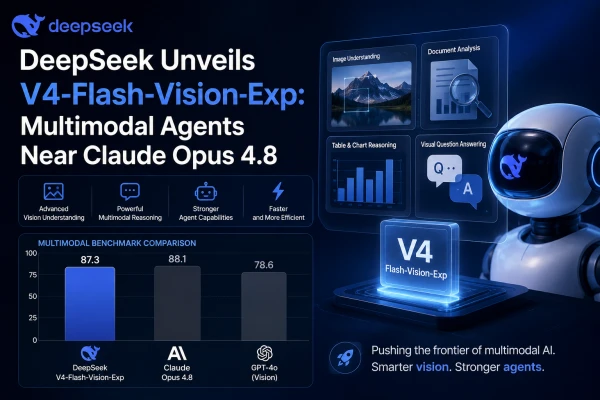
DeepSeek has released DeepSeek-V4-Flash-Vision-Exp, an experimental multimodal model that adds native image understanding to its efficient V4-Flash architecture while preserving the base model's strong text, reasoning, and agent performance.
The model went live on the DeepSeek API platform on August 21, 2026. Developers access it by setting the model parameter to deepseek-v4-flash-vision-exp.
It supports mixed text-and-image inputs and is designed for agentic workflows that combine visual understanding with tool use.
According to DeepSeek's official changelog and API documentation, the vision variant matches the official DeepSeek-V4-Flash on pure-text capabilities, including agents, reasoning, and world knowledge.
On agent benchmarks that require visual understanding, it delivers a significant leap over the text-only Flash model and brings multimodal agent performance close to Anthropic's Claude Opus 4.8.
Reported scores on public and internal benchmarks include 83.9 on Terminal Bench 2.1, 57.7 on NL2Repo, 59.3 on DeepSWE, 63.6 on DSBench-Hard, 25.7 on AutomationBench (Public), 36.5 Pass@1 on ApexBench, 27.3 on Agents' Last Exam, 64.3 on Chartography, and 35.0 Pass@5 on ZeroBench. DeepSeek notes that in some evaluations the text-only V4-Flash simply ignored multimodal elements, which helps explain part of the observed gains.
The underlying V4-Flash is a mixture-of-experts model with 284 billion total parameters and 13 billion active per token. It was trained on 32 trillion tokens and uses techniques such as HCA and CSA for KV-cache compression that cut the compute needed for 1-million-token contexts by roughly 73 percent. V4-Flash-Vision-Exp inherits this efficiency while adding vision.
Images are tokenized for billing at the same rates as V4-Flash text tokens, with a hard cap of 384 tokens per image regardless of resolution. The model normalizes inputs to approximately 800 by 800 pixels and supports JPEG, PNG, GIF, and WebP.
Developers can supply images via Base64, public URLs (up to 32 MiB), or the newly launched free Files API. The Files API lets users upload an image once and reference it by file_id across multiple requests, reducing bandwidth for multi-turn agent sessions.
A single request can include up to 600 images, subject to edge-length limits that tighten with higher image counts.
The model works with OpenAI-compatible Chat Completions and Responses APIs as well as Anthropic's Messages endpoint, making it straightforward to drop into existing agent frameworks. DeepSeek simultaneously released Harness 0.1.1 with built-in support for the new model, enabling out-of-the-box use in visual agent pipelines.
In practical terms, the model can describe images, extract text from screenshots, analyze diagrams and charts, and combine those capabilities with tool calling. This positions it for tasks such as UI automation, document understanding, visual research assistants, and multi-step agents that must interpret screens or diagrams while writing code or calling external tools.
DeepSeek frames the release as experimental. Availability is currently limited to the paid developer platform, though the company has a history of open-sourcing earlier models. Pricing follows the established V4-Flash schedule, which has been among the more cost-effective options for high-volume agent workloads.
The launch continues DeepSeek's pattern of rapid iteration on efficient, agent-oriented models. Earlier in 2026 the lab introduced the V4 series with both the larger V4-Pro and the lighter V4-Flash, emphasizing long-context efficiency and strong coding and tool-use performance at lower cost than many frontier closed models.
Adding vision closes a gap that limited Flash's usefulness in real-world agent scenarios where screenshots, charts, or interface elements are common.
Independent coverage from outlets including SiliconANGLE and The Decoder confirms the official numbers and notes that the model outperforms Opus 4.8 on at least two visual agent benchmarks (ALE and ZeroBench) while remaining competitive overall.
Independent verification of the full suite of scores is still emerging, as is typical for newly released experimental models.
For developers already running agents on V4-Flash, the upgrade path is straightforward: change the model name, add image inputs where needed, and optionally switch to the Files API for repeated visual context.
The combination of low per-token cost, 1-million-token context, and now native vision makes the model particularly interesting for high-volume or latency-sensitive visual agent applications.
Whether the experimental designation will evolve into a stable production model, and whether weights will eventually be released, remains to be seen. For now, the API availability and documented benchmark gains give teams a concrete new option for multimodal agent work without moving up to the higher price tiers of the largest closed models.
DeepSeek's continued focus on efficient architectures and agent harnesses underscores a broader industry shift: model capability alone is no longer the only lever. How models handle vision, long contexts, and tool use inside practical agent loops increasingly determines real-world usefulness. V4-Flash-Vision-Exp is the latest data point in that direction.