
DeepSeek Is Developing Its Own AI Chip to Challenge Nvidia and Strengthen China's Artificial Intelligence Industry
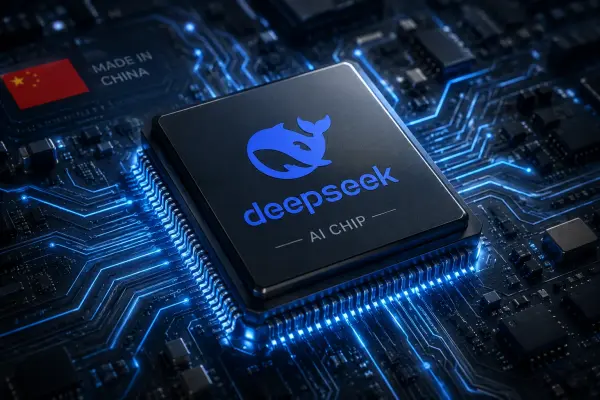
Chinese artificial intelligence startup DeepSeek is taking a major step beyond software by developing its own AI chip, according to people familiar with the project.
The company, which gained worldwide attention after releasing powerful large language models at significantly lower costs than many competitors, is now investing in custom semiconductor technology to reduce its dependence on foreign hardware suppliers and strengthen its position in the rapidly expanding AI industry.
The new chip is expected to focus primarily on AI inference, the stage where trained artificial intelligence models generate responses for users. Inference has become one of the fastest-growing segments of the AI market because millions of people now interact with AI chatbots, coding assistants, image generators, and business automation tools every day. Developing its own inference chip would allow DeepSeek to optimize performance while lowering long-term operating costs.
For years, Nvidia has dominated the global AI chip market with graphics processing units that power many of the world's leading AI models, including systems developed by OpenAI, Anthropic, Google, Meta, and Microsoft.
However, growing demand, high prices, and U.S. export restrictions have encouraged AI companies around the world to explore custom hardware designed specifically for their own workloads. DeepSeek's latest initiative reflects this broader industry trend.
The project reportedly began about a year ago, with DeepSeek quietly hiring semiconductor engineers and exploring partnerships with manufacturing and memory suppliers.
Although the chip remains in the early stages of development, the company hopes custom hardware will provide greater control over its AI infrastructure while reducing exposure to international supply chain disruptions.
Building competitive AI chips is an extremely complex undertaking, but success could significantly improve DeepSeek's ability to deploy future AI models at scale.
The move comes as China's artificial intelligence industry continues adapting to U.S. export controls on advanced semiconductors. Restrictions on Nvidia's most powerful AI processors have encouraged Chinese technology companies to accelerate investment in domestic alternatives.
While Huawei has become one of China's leading AI hardware providers, DeepSeek's decision to design its own chip demonstrates that software companies are increasingly looking to control both AI models and the hardware that powers them.
DeepSeek's ambitions also mirror strategies adopted by several major global AI companies. OpenAI has developed custom inference chips with Broadcom, Google continues expanding its Tensor Processing Units, Amazon builds Trainium and Inferentia processors, and Microsoft has introduced Maia AI accelerators for Azure.
Rather than relying entirely on third-party suppliers, AI developers increasingly view proprietary hardware as a strategic advantage capable of improving performance while reducing operating expenses.
Industry analysts believe the global AI race is entering a new phase where success depends on more than simply building better language models. Companies must also secure access to advanced computing infrastructure, reliable energy, high-performance networking, and specialized semiconductors capable of supporting increasingly sophisticated AI workloads. Custom chips have therefore become one of the most valuable assets for companies competing at the frontier of artificial intelligence.
Although DeepSeek still faces significant engineering and manufacturing challenges before its chip reaches production, the project demonstrates the company's growing ambitions. If successful, the move could reduce costs, improve efficiency, and strengthen China's position in the increasingly competitive global AI market.
As artificial intelligence continues transforming industries around the world, the battle for AI leadership is expanding beyond software and into the highly strategic world of semiconductor innovation.