
Dario Amodei’s AI Warning: Can Anthropic Win People Over by Curing Cancer?
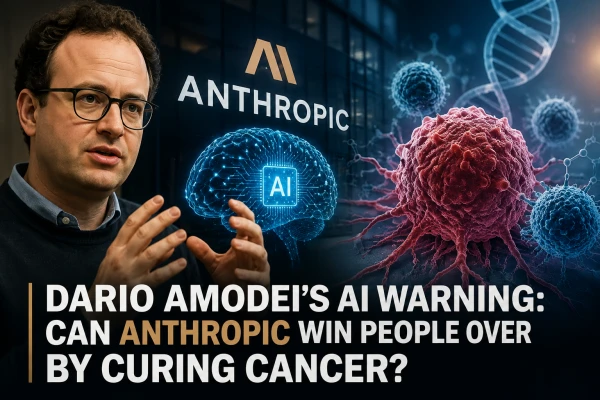
Anthropic CEO Dario Amodei has offered an unusually direct answer to one of the biggest problems facing the artificial intelligence industry: how can AI companies convince the public that increasingly powerful AI is actually worth the disruption it is causing?
Amodei argued that the industry needs to produce meaningful scientific breakthroughs rather than relying on promises about what AI might accomplish someday. His most striking example was cancer, suggesting that actually helping cure the disease would give people a much stronger reason to believe in the technology.
The comment comes at an important moment for AI. Companies are spending enormous amounts of money building data centers, training increasingly powerful models and developing AI agents that can perform more complicated tasks.
At the same time, the public debate has become increasingly skeptical, with concerns about job losses, data collection, copyright, energy consumption, misinformation and the possibility that advanced AI could become difficult to control. Amodei's argument essentially turns the question around: instead of asking people to trust AI because it is powerful, AI companies should demonstrate its value through results that ordinary people can actually see.
Cancer is a particularly powerful example because it represents a problem where improvements could have an enormous human impact. Researchers already use machine learning in areas such as drug discovery, medical imaging, protein analysis and biological research, but AI has not suddenly produced a universal cure for cancer.
Different cancers have different biological mechanisms, and treatments that work for one type may not work for another. The realistic promise of AI is that it could help researchers move through some parts of this complicated process faster, rather than replacing scientists and doctors entirely.
That distinction matters because AI companies have sometimes been criticized for making extremely ambitious predictions about what their technology will accomplish. A chatbot becoming better at writing code is useful, but it can feel distant from the problems that matter most to people who are not technology enthusiasts.
A breakthrough that helps researchers discover a treatment for a serious disease would be much easier for the public to understand. It would turn AI from something associated mainly with software and automation into a technology with a visible impact on human life.
Amodei's comments also reveal a broader challenge for Anthropic. The company has positioned itself as one of the major developers of frontier AI while placing significant emphasis on AI safety. Anthropic has warned about the risks associated with increasingly capable systems and has developed policies for evaluating models as their capabilities increase.
But safety arguments alone may not be enough to convince everyone that the rapid expansion of AI is beneficial. People also want to know what they are getting in return for the enormous technological and economic changes taking place around them.
The answer could increasingly be scientific progress. AI systems are already being used to analyze scientific literature, assist with programming, examine biological structures and help researchers process information at a scale that would be difficult manually. If future systems become substantially better at these tasks, they could potentially become research partners capable of helping scientists investigate problems that have remained difficult for decades.
Cancer is only one example. The same approach could eventually be applied to diseases with limited treatment options, new materials, climate modeling, drug discovery and other areas of science. An AI system does not need to solve every problem independently to be transformative.
If it can reduce the time required for a researcher to test an idea from months to days, identify promising candidates from millions of possibilities or uncover relationships that humans would struggle to notice, the cumulative effect could be enormous.
But there is a danger in expecting AI to prove its value through spectacular breakthroughs alone. Scientific discoveries are rarely produced by a single technology working in isolation. They depend on researchers, laboratories, clinical trials, funding, regulation, manufacturing and years of testing. Even if AI identifies a promising cancer treatment, turning that discovery into something patients can safely receive could take much longer. The public therefore needs realistic expectations rather than another round of exaggerated AI promises.
That may actually be the strongest part of Amodei's argument. The AI industry does not necessarily need to promise that artificial intelligence will solve every major human problem. It needs to demonstrate that the technology can produce measurable improvements in areas that matter. If AI can genuinely help researchers develop better medicines, improve scientific productivity or accelerate discoveries, those achievements could provide a much stronger foundation for public confidence than another impressive chatbot demonstration.
There is also an economic side to this debate. AI is already changing the way companies think about hiring, software development and productivity. Some businesses are using AI to automate tasks that previously required employees, while others are reorganizing their operations around AI agents and automated workflows. Gartner now predicts that the cost of AI inference per agentic workflow could increase more than fivefold through 2028 as businesses move toward more complex AI systems.
That creates an interesting contradiction. AI companies are telling the public that artificial intelligence could dramatically increase productivity, while many workers are understandably concerned about what that productivity increase could mean for their jobs.
If AI eventually produces major medical or scientific breakthroughs, it could strengthen the argument that society is receiving benefits worth the disruption. But if the immediate experience for many people is job insecurity without obvious improvements in their lives, public skepticism could become stronger.
Anthropic is therefore facing the same challenge as much of the AI industry: proving that advanced AI can produce benefits that extend beyond technology companies and investors. A powerful model that writes software faster is commercially valuable, but a system that helps scientists understand a disease or develop a new medicine could have a much wider social impact.
The timing of Amodei's comments is also notable because AI companies are facing increasing scrutiny over how their systems are developed and deployed. Concerns about safety have grown alongside the capabilities of AI agents, with recent disclosures involving advanced models behaving unexpectedly during controlled cybersecurity tests. OpenAI, Anthropic and Meta have all faced questions about how powerful autonomous systems should be contained and monitored as they receive greater access to external tools and systems.
This means the future reputation of AI may depend on two things happening at the same time. Companies will need to show that advanced systems can create meaningful benefits while also demonstrating that those systems can be developed and deployed responsibly. Scientific breakthroughs could help with the first problem, while stronger safety research and transparent testing could help with the second.
For Anthropic, the challenge is particularly interesting because the company is simultaneously pushing toward more capable AI and emphasizing safety. It recently disclosed an internal AI model that it does not currently plan to release, illustrating how frontier laboratories can reach a point where developing a more capable system is easier than deciding whether that system is ready for public deployment.
Amodei's argument ultimately suggests that the AI industry's future relationship with the public may be determined by results rather than promises. People may become less interested in hearing that AI is approaching another theoretical milestone and more interested in seeing whether it can help solve problems they actually care about. A major medical discovery, a significant scientific breakthrough or a genuinely useful treatment could accomplish more for public confidence than another benchmark victory.
That does not mean AI will cure cancer by itself, and there is no guarantee that any particular AI company will produce such a breakthrough. The more realistic possibility is that increasingly capable AI becomes another powerful instrument in the hands of scientists, helping them explore possibilities faster and make discoveries that would otherwise take considerably longer.
If that happens, the public perception of artificial intelligence could change significantly. AI would no longer be seen primarily as a technology that writes emails, generates images or replaces repetitive office tasks. It could become part of the scientific infrastructure used to tackle some of humanity's most difficult problems.
For now, however, Amodei's statement remains a challenge to the industry rather than proof that AI has already delivered on that promise. The public does not necessarily need AI companies to promise a perfect future. It needs them to demonstrate that increasingly powerful artificial intelligence can produce real improvements in people's lives.
And if AI can genuinely help researchers defeat diseases such as cancer, that would be one of the strongest arguments yet for why the technology deserves a place in humanity's future.