
Chinese Humanoid Robots Beat Usain Bolt’s 100m Record at Beijing World Games
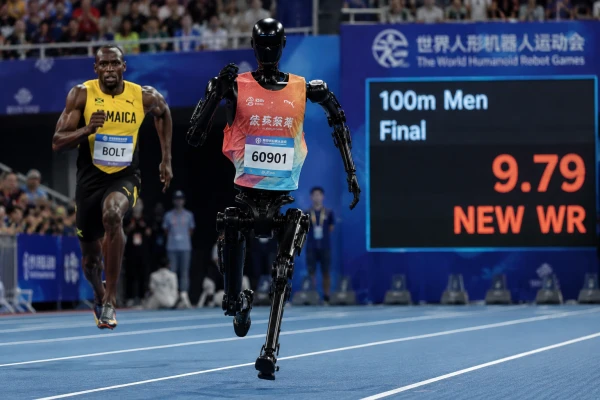
A Chinese humanoid robot named Tiangong Ultra ran 100 metres in 9.39 seconds during a preliminary heat at the second World Humanoid Robot Games in Beijing on Saturday, faster than the men’s world record of 9.58 seconds held by Jamaican sprinting great Usain Bolt since 2009.
Honor’s Lightning robot finished second in the same heat in 9.47 seconds, also under Bolt’s mark. Both results represent a dramatic leap from the inaugural games in 2025, when Tiangong Ultra’s winning time was 21.50 seconds.
The robots competed at the National Speed Skating Oval, the “Ice Ribbon” venue built for the 2022 Winter Olympics. Organisers said more than 2,000 humanoid robots from 666 teams across 16 countries took part in the five-day event, which features 51 disciplines ranging from athletics and soccer to industrial task simulations, table tennis, weightlifting and tug-of-war.
Tiangong Ultra, developed by the Beijing Humanoid Robot Innovation Center, started behind Lightning but surged past it near the finish. Chinese state media earlier reported that Lightning had clocked 9.32 seconds in a preparatory test, reaching a peak speed of 14.5 metres per second. Researchers lengthened Lightning’s legs by 10 cm ahead of the games after the robot had already set a strong mark in a humanoid half-marathon earlier in the year.
Braking remained a clear limitation. After crossing the line, several robots continued into thick protective mats or cushioned walls placed beyond the finish and required assistance to recover balance. One report noted robots being carried away on stretchers after high-speed runs, highlighting that controlled deceleration and stability after maximum effort still lag behind acceleration performance.
The high-jump event produced a similarly striking result. A humanoid cleared 2.88 metres in a standing jump, well above the previous year’s best robotic mark of 0.95 metres and higher than the human world record of 2.45 metres set by Cuba’s Javier Sotomayor in 1993. Both the sprint and jump records were attributed to robots associated with Beijing-based X-Humanoid or the Beijing Humanoid Robot Innovation Center.
On the second day of competition, Tiangong Ultra (also referred to as Tien Kung Ultra) won the first gold medal of the games in the 400-metre final, clocking 38.15 seconds—faster than the human world record of 43.03 seconds held by South Africa’s Wayde van Niekerk. Other finalists using Lightning platforms finished between 39.45 and 40.08 seconds.
The rapid improvement underscores China’s aggressive push in humanoid robotics. Chinese companies dominate global production volumes, and policymakers have designated the sector a strategic priority for manufacturing, logistics, services and future economic growth. Unitree Robotics, one of the best-known Chinese makers, saw its shares surge dramatically on its Shanghai STAR Market debut earlier in the week, reflecting strong investor enthusiasm.
Yet industry leaders remain measured about commercial readiness. Unitree founder Wang Xingxing told a forum at the concurrent World Robot Conference that a true “ChatGPT moment” for humanoids—reliable performance of most everyday tasks in unfamiliar environments—still lies two to ten years away. Other Chinese founders offered more optimistic timelines of one to two years for practical autonomy.
The games deliberately mix spectacle sports with scenario-based challenges designed to test real-world usefulness: parcel sorting, phone packing, hospitality service, household chores and emergency response. Organisers expanded these practical events this year to accelerate the shift from demonstration to deployment.
Technical progress is visible in actuator power, balance control, perception and locomotion algorithms. Many robots now combine vision-language models with whole-body control policies that allow dynamic running, jumping and multi-contact skills. However, energy efficiency, battery life, robust perception under variable lighting, and safe interaction with humans in unstructured spaces remain open challenges.
Geopolitical context adds weight to the results. The United States has tightened scrutiny of Chinese robotics firms, including adding Unitree to certain restricted lists. China has rejected the national-security framing and continues to promote large-scale domestic development and export ambitions.
For researchers and investors, the Beijing times serve as a public benchmark. Cutting more than 12 seconds from the previous year’s 100-metre best in a single development cycle demonstrates how quickly hardware, software and training pipelines are advancing. At the same time, the need for crash mats and recovery assistance shows that peak speed alone does not equal robust, production-ready locomotion.
The World Humanoid Robot Games continue through Wednesday. Further finals in sprinting, jumping, team sports and industrial scenarios will provide additional data points on the current state of bipedal machines. Whether these record times translate into reliable factory or service robots in the near term remains the central question for the industry.
What is already clear is that humanoid performance envelopes are expanding faster than many expected only a year ago. The gap between laboratory demos and competitive results is closing, and the next generation of platforms will be measured against both human athletic records and practical workplace metrics.