
About Mark Zuckerberg’s Personal AI: Will Everyone Have Their Own Superintelligence?
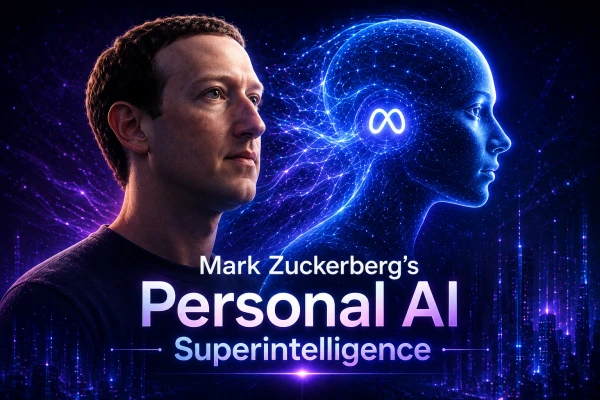
Mark Zuckerberg is betting that the next major stage of artificial intelligence will not simply be about giving people a smarter chatbot. His vision is much more personal: AI systems that understand an individual’s goals, interests and circumstances and continuously help that person make decisions, create things and accomplish tasks.
In his recent essay, “The Future Is for Everyone,” Zuckerberg described a future centered around personal superintelligence, arguing that advanced AI should become something individuals can use directly rather than technology controlled only by large institutions.
The idea sounds futuristic, but parts of it are already beginning to appear in today's AI products. People can already ask AI assistants to summarize information, write messages, plan trips, analyze documents, generate ideas and help with coding.
The major difference in Zuckerberg’s vision is that the AI would become much more continuous and personalized. Instead of waiting for someone to open an AI application and type a question, the system could potentially remain available throughout the day and help with different parts of a person's life.
Imagine an AI that understands that you are trying to start a business, knows the skills you are learning, remembers the projects you are working on and understands the kind of work you want to do. Instead of asking it the same background questions repeatedly, you could simply tell it what you are trying to accomplish and allow it to suggest the next useful action. That would make the AI feel less like a search box and more like a personal digital partner.
Zuckerberg believes this kind of personal AI could eventually help people with areas such as careers, health and personal interests. The underlying idea is that intelligence becomes increasingly available to individuals, allowing one person to accomplish things that previously required a much larger team.
His argument is that AI could lower the barriers to creating businesses, products and other projects by giving individuals access to capabilities that were once expensive or difficult to obtain.
This could be particularly important for small businesses. A person with an idea could potentially use AI to research the market, develop a website, create marketing material, analyze customer feedback, write software and manage routine administrative tasks.
The person would still need to make important decisions, but AI could handle more of the work between those decisions. A business that previously required several employees for routine digital tasks could potentially operate with a much smaller team.
The biggest change, however, could be personalization. Current AI assistants generally know only what a user tells them during a conversation or what the platform allows them to access. A future personal AI could potentially build a much deeper understanding of an individual over time. It could learn what the person is trying to achieve, recognize recurring problems and use previous interactions to make future assistance more useful.
That creates an enormous opportunity, but it also creates an equally enormous privacy question. An AI that genuinely understands a person would need access to a considerable amount of information. The more useful the assistant becomes, the more information it may need to process.
This could include schedules, messages, documents, preferences, work activities and other personal information. The question would therefore become not simply whether AI can know you, but who controls everything the AI knows about you.
There is also a difference between an AI that remembers information and an AI that understands priorities. A useful personal assistant would need to recognize that not every piece of information is equally important. If someone is trying to grow a business, for example, the AI should understand that a customer complaint may require more attention than an unimportant notification. That kind of prioritization is one of the areas where future AI agents could become much more useful than today's simple chat interfaces.
Meta is already pushing AI beyond traditional chatbots through devices such as its AI glasses. The company has described AI glasses as tools that can help people work, learn and live more independently, including applications where the glasses can identify objects, read text and assist users through voice interactions.
That hardware could eventually become important to the personal AI vision because an AI assistant becomes more useful when it can understand what is happening around its user. A chatbot sitting inside a website knows what you type into it. An AI connected to cameras, microphones and wearable devices could potentially understand much more about the user's environment and provide assistance based on what is actually happening.
For example, someone wearing AI glasses could potentially walk into a new environment and ask the assistant to identify something, translate a sign or explain what they are looking at. In a business setting, the same technology could help a worker understand equipment, follow instructions or retrieve information without stopping to look at a phone or computer.
This is where personal AI begins to move toward the idea of an AI agent. Instead of simply answering questions, the system could eventually take actions on behalf of the user. It might organize information, communicate with services, prepare documents, monitor tasks and complete routine digital work. The user would provide a goal while the AI handles many of the smaller steps required to reach it.
The technology is still far from Zuckerberg’s full vision, however. Today's AI agents can make mistakes, misunderstand instructions and sometimes require human supervision. Giving an AI more access to personal information and external systems also increases the potential consequences of an error. A chatbot producing a bad answer is one problem; an AI that automatically sends an email, purchases something or changes an important account is a much bigger one.
That is why the future of personal AI will probably depend as much on reliability and control as intelligence. People will not trust an assistant with important parts of their lives simply because it is good at answering questions. They will need confidence that it knows when to act, when to ask for permission and when to stop.
Zuckerberg's argument also challenges the idea that AI will necessarily concentrate power inside the biggest companies. His vision is that personal AI could distribute advanced intelligence to individuals, allowing ordinary people to use technology that previously required large organizations. Meta has also continued pushing open-weight AI models, arguing that developers should have greater access to AI technology rather than relying entirely on a small number of closed systems.
If that happens, the economic effects could be significant. A person with limited technical skills could potentially use AI to perform tasks that previously required programmers, designers, analysts, researchers and marketers. The advantage would not necessarily belong only to people who know how to build AI. It could increasingly belong to people who know how to direct AI effectively.
The future could therefore produce a strange situation where individuals become much more capable without necessarily becoming experts in every field. Someone could use an AI assistant to help design a product without being a professional designer, build software without being an experienced programmer and conduct market research without being a professional analyst. The human would still provide judgment and direction while the AI supplies much of the specialized execution.
But there is another possible outcome. If everyone's personal AI becomes extremely capable, the advantage may shift from simply having access to AI toward having better ideas, better judgment and better goals. When the cost of producing content, software or business plans becomes much lower, the difficult part may become deciding what is actually worth producing.
That is why personal superintelligence could eventually be more significant than another chatbot upgrade. The biggest change may not be that AI becomes slightly better at answering questions. It may be that people stop thinking of AI as something they visit when they need help and start treating it as a permanent digital layer around their daily lives.
The technology is not there yet, and Zuckerberg's vision should be understood as a prediction and strategy rather than a description of something people can fully use today. But the direction is already visible. AI is moving from simple question-and-answer systems toward agents, wearables and personalized tools that can remain involved in people's activities for much longer periods.
If that development continues, the phrase “personal AI” could eventually mean something very different from today's AI assistant. It could refer to an AI that knows your objectives, understands your preferences, monitors the information you choose to share and helps coordinate the digital parts of your life.
The most important question may then be whether people will actually want an AI that knows them that well. The convenience could be enormous, but so could the responsibility. Whoever controls the personal AI layer could potentially have an extraordinary amount of influence over how people find information, make decisions and interact with technology.
That is ultimately what makes Zuckerberg's vision worth watching. The next AI revolution may not be about one company creating a chatbot that is smarter than everyone else's. It could be about giving every individual an AI system that becomes increasingly capable of working specifically for them. And if that happens, the relationship between humans and AI could change much more profoundly than another model upgrade ever could.