
Why Nvidia Is Spending $5 Billion on Ilya Sutskever's Secret AI Startup
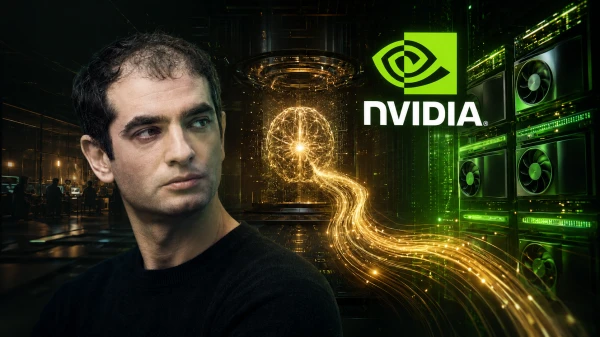
The competition to build the world's most advanced artificial intelligence systems has entered another major phase after Nvidia committed up to $5 billion to Safe Superintelligence (SSI), the secretive AI company founded by former OpenAI chief scientist Ilya Sutskever.
The agreement represents one of Nvidia's largest strategic AI investments and highlights how the world's leading chipmaker is expanding beyond hardware sales into direct partnerships with frontier AI laboratories.
According to reports, the investment is tied to long-term milestones that will significantly increase SSI's computing capacity while supporting the development of new AI research that remains largely hidden from public view.
Safe Superintelligence has become one of Silicon Valley's most closely watched startups despite revealing very little about the technology it is building. Since leaving OpenAI in 2024, Sutskever has repeatedly said the company's only objective is creating artificial superintelligence that is both highly capable and fundamentally safe.
Unlike many AI startups racing to release chatbots or enterprise products, SSI has concentrated almost entirely on long-term scientific research. That unusual strategy has attracted billions of dollars from investors who believe the next generation of AI breakthroughs will come from focused research rather than rapid commercial expansion.
Nvidia's involvement is particularly important because modern frontier AI depends on enormous amounts of computing power. Training advanced models requires tens of thousands of high-end GPUs connected through specialized networking systems inside massive data centers.
By backing SSI financially while providing access to its newest Vera Rubin AI hardware, Nvidia is helping the startup secure the resources needed to compete with organizations such as OpenAI, Google DeepMind, Anthropic and xAI. Compute has become one of the most valuable assets in artificial intelligence, and companies with guaranteed access to cutting-edge hardware often gain a significant competitive advantage.
The investment also reflects Nvidia's changing role within the AI ecosystem. The company is no longer simply supplying processors to technology firms. It is increasingly becoming a strategic partner that helps finance ambitious AI projects while ensuring its newest hardware remains at the center of frontier model development.
Similar partnerships have emerged across the industry as AI companies require unprecedented amounts of capital to build larger data centers, purchase advanced chips and train increasingly sophisticated models.
One reason SSI continues attracting investor interest is the reputation of its founder. Ilya Sutskever is regarded as one of the pioneers of modern deep learning and played a central role in the development of several breakthrough AI systems during his time at OpenAI.
Many investors believe his experience gives SSI a realistic opportunity to develop technologies capable of redefining the limits of artificial intelligence. Reports indicate the company has already reached a valuation exceeding $30 billion, despite not releasing a commercial AI model.
Industry analysts believe Nvidia's latest investment also signals a broader shift in AI competition. The next generation of leaders will likely be determined not only by software innovation but also by access to infrastructure, electricity, financing and semiconductor supply. Building frontier AI models now requires resources that only a handful of organizations can assemble.
Strategic partnerships between hardware manufacturers and AI research companies are therefore becoming increasingly important as the cost of training advanced models continues to rise.
Although Safe Superintelligence has shared almost nothing about its research roadmap, the partnership with Nvidia suggests development is progressing rapidly behind closed doors.
Additional computing capacity will allow researchers to run larger experiments, evaluate new architectures and explore approaches that may differ significantly from today's large language models. If SSI succeeds, its work could influence the next era of artificial intelligence and reshape how future AI systems are designed.
Nvidia's multi-billion-dollar commitment demonstrates that the race toward superintelligence is accelerating. Rather than waiting to see which laboratory achieves the next major breakthrough, Nvidia is investing directly in the researchers it believes could define the future of AI.
As competition between OpenAI, Google DeepMind, Anthropic, xAI and emerging startups continues to intensify, partnerships of this scale are becoming one of the strongest indicators of where the artificial intelligence industry is heading next.