
What Did Sam Altman Mean by the AI Singularity? A Simple Explanation
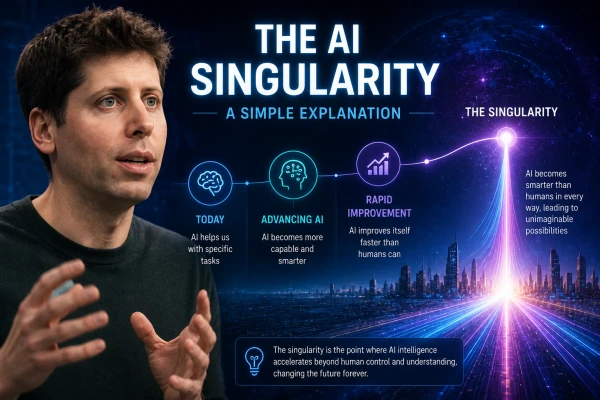
When OpenAI CEO Sam Altman said that humanity has entered the AI singularity, the statement quickly spread across social media and technology websites. For many people, the phrase sounded dramatic, while others wondered whether it meant artificial intelligence had already become smarter than humans.
The reality is more nuanced. Altman's comments were not about robots taking over the world tomorrow. Instead, they reflected his belief that AI has reached a point where it will permanently change how people live, work and create.
The term AI singularity has been discussed by scientists and futurists for decades. It generally describes a moment when artificial intelligence becomes capable of improving itself faster than humans can understand or control.
Once AI reaches that stage, technological progress could accelerate rapidly, leading to discoveries and inventions that are difficult to predict today. While experts disagree on exactly when this could happen—or even whether it will happen at all—many believe AI is advancing faster than expected.
What Sam Altman Actually Meant
Sam Altman argues that the world has already crossed an important threshold. According to his view, artificial intelligence is no longer just another software tool. It has become a general-purpose technology that is beginning to transform almost every industry, from healthcare and education to finance, software development and scientific research.
Rather than suggesting that superintelligent machines already exist, Altman believes the singularity is beginning because AI systems are now helping humans create better AI systems. Researchers use AI to write code, analyze research papers, design computer chips and speed up scientific discoveries. This creates a feedback loop where every improvement makes future improvements happen even faster.
Why This Is Different From Previous Technology
Throughout history, major inventions such as electricity, the internet and smartphones changed society over many years. Artificial intelligence is different because it can actively participate in its own development.
Modern AI models assist researchers with programming, mathematics, engineering and problem-solving, allowing new technologies to emerge more quickly than before.
This rapid acceleration explains why many technology leaders believe the next decade could produce more change than the previous several decades combined.
AI Is Already Changing Everyday Life
For millions of people, the singularity may not feel like a distant concept because AI is already becoming part of daily routines.
Today, artificial intelligence helps people:
- Write emails and reports.
- Generate software code.
- Create professional images and videos.
- Translate languages instantly.
- Analyze business data.
- Assist doctors with medical research.
- Support students with learning.
- Automate repetitive office work.
Just a few years ago, many of these tasks required significant human effort. Today they can often be completed in minutes using advanced AI systems.
Does This Mean Artificial General Intelligence Exists?
Not necessarily.
Artificial General Intelligence (AGI) usually refers to an AI system capable of performing nearly every intellectual task at or above human level. While many companies, including OpenAI, continue working toward AGI, there is no public confirmation that such a system currently exists.
Altman's comments suggest something slightly different: even before AGI arrives, current AI systems are already powerful enough to fundamentally reshape economies, industries and everyday life.
Why Some Experts Disagree
Not everyone agrees that humanity has entered the singularity.
Some AI researchers believe current models still struggle with reasoning, long-term planning and factual accuracy. Others argue that today's systems remain advanced prediction engines rather than truly intelligent thinkers.
There are also concerns about AI safety. As models become more capable, governments and technology companies are investing heavily in research aimed at preventing misuse, reducing hallucinations and ensuring advanced AI remains aligned with human goals.
Because of these uncertainties, many experts describe today's AI progress as the beginning of a long transition rather than the singularity itself.
What This Means for Businesses
For businesses, Altman's comments are less about science fiction and more about preparation.
Companies that begin adopting AI today may gain significant advantages in productivity, customer service, marketing and software development. Organizations delaying AI adoption could find themselves competing against businesses that operate faster and more efficiently through automation.
Industries such as healthcare, finance, manufacturing, education and cybersecurity are already integrating AI into everyday operations, and that trend is expected to continue over the coming years.
What It Means for Everyday People
For individuals, the AI singularity is not something to fear but something to understand.
Learning how AI works, using it responsibly and developing skills that complement artificial intelligence will become increasingly valuable.
Just as computers and the internet created entirely new careers, artificial intelligence is expected to create opportunities that barely exist today while changing many existing jobs.
The people who adapt early are likely to benefit the most from these changes.
Final Thoughts
Whether or not humanity has officially entered the AI singularity remains a matter of debate. However, Sam Altman's statement reflects a growing belief among technology leaders that artificial intelligence has reached a historic turning point.
AI is no longer a niche research project—it is becoming a foundational technology that influences business, education, science and daily life.
The real significance of Altman's message is not that machines have suddenly become all-powerful. It is that the pace of technological progress is accelerating, and artificial intelligence is now driving much of that acceleration.
As new models become more capable and AI continues to integrate into every aspect of society, understanding concepts like the AI singularity will become increasingly important for businesses, developers and everyday users alike.