
UAE Revises AI Data Center Plan After Iranian Attacks
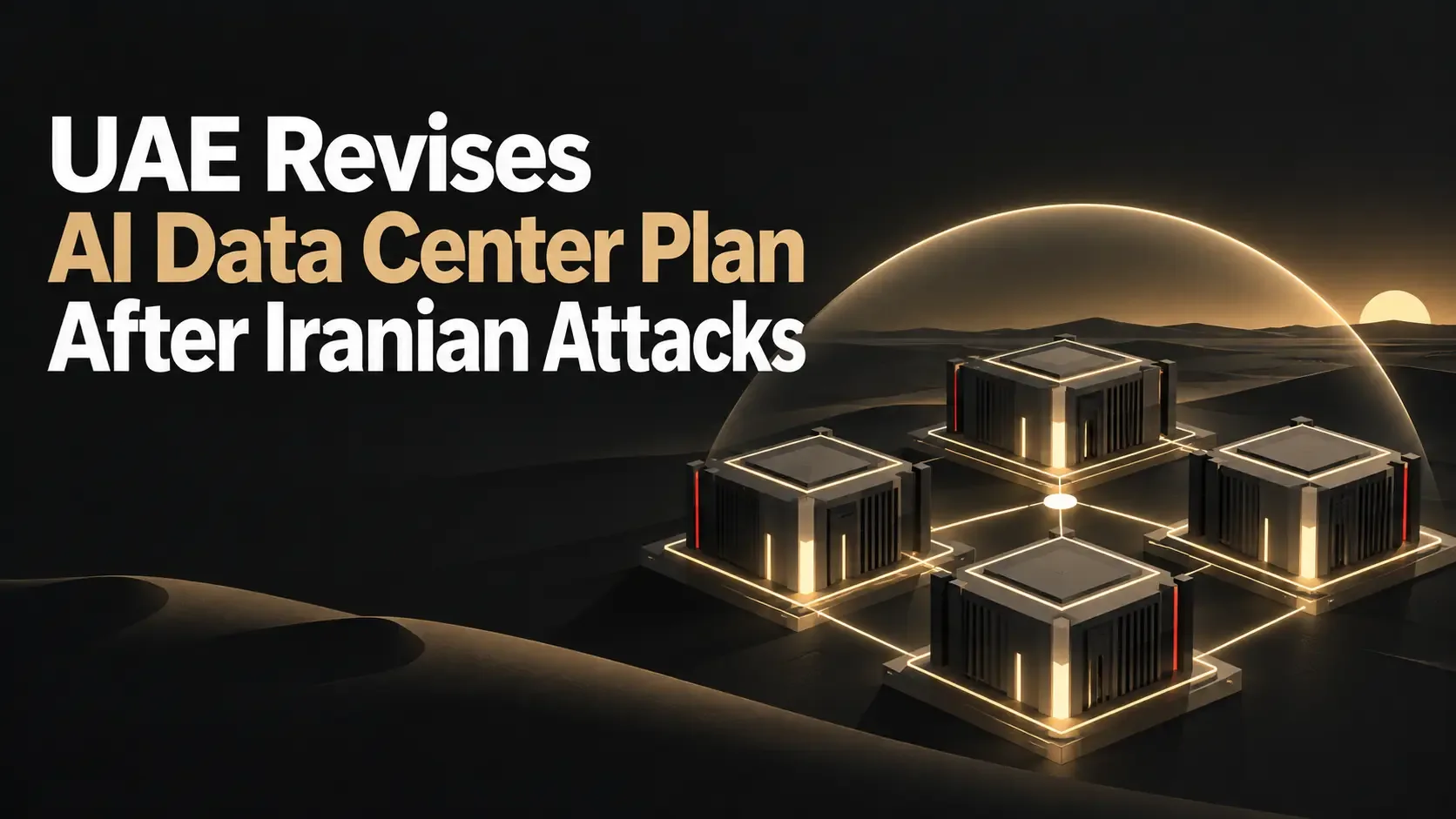
The UAE AI data center plan is being redesigned after Iranian attacks exposed the physical vulnerability of Gulf cloud infrastructure. The 5-gigawatt project, originally conceived as one vast Abu Dhabi campus, is now likely to become a distributed network of facilities across the Emirates.
The reported redesign centers on four defenses:
- Distributing capacity across multiple sites
- Building some infrastructure underground
- Adding blast-resistant structures and redundant utilities
- Integrating missile, drone and electronic defenses
UAE Revises AI Data Center Plan After Gulf Attacks
Reuters reported on September 11 that six people familiar with the deliberations described a broad review prompted by the Iran war. Four said the original 10-square-mile, or 26-square-kilometer, campus would probably be divided among locations across the UAE.
The revised masterplan has not been finalized, and Reuters could not determine how the work might affect costs or deadlines. That uncertainty matters: the project is one of the largest planned AI computing developments outside the United States, and its first capacity is scheduled for this year.
G42, the Emirati AI company leading the development, told Reuters that work was progressing as planned. It added that project specifics undergo continuous review against the security, resilience and operational standards expected for infrastructure of this scale.
OpenAI separately said progress was being made on infrastructure and adoption priorities. Nvidia, Oracle and Cisco did not respond to Reuters, while SoftBank declined to comment. The distinction is important: a reported redesign does not mean construction has stopped or the project has been cancelled.
Stargate UAE Keeps Its 1-Gigawatt First Phase
The first construction phase is expected to continue, although Reuters said protective modifications are being considered. That phase is the $30 billion Stargate UAE cluster, designed for 1 gigawatt of compute with an initial 200 megawatts due to come online in 2026.
OpenAI’s May 22, 2025 announcement confirms the 1-gigawatt cluster, the 200-megawatt target and the partner roster of G42, Oracle, Nvidia, Cisco and SoftBank. It described the deployment as the first international expansion of the Stargate infrastructure platform.
The broader UAE-US AI Campus was planned for 5 gigawatts. Reuters reported that the original design concentrated that capacity on a single site near Al Dhafra Air Base outside Abu Dhabi, a location that had not previously been made public.
For the first phase, concentration still provides engineering advantages: shared power, cooling, networking and operations can reduce complexity. The new security calculus introduces a competing priority, because one highly visible cluster can also create a single physical point of failure.
Iran Attacks Change the Infrastructure Threat Model
The review followed Iranian missile and drone attacks on Gulf states hosting American forces. Reuters said two Amazon Web Services data centers in the UAE and one in Bahrain were damaged in March, leaving regional cloud services disrupted months later.
Iran’s armed forces then released an April video identifying Stargate UAE as a potential target. The combination of actual cloud damage and an explicit threat transformed physical security from a design consideration into a core architectural constraint for the new AI campus.
Officials are considering underground construction, blast-resistant concrete, backup power and redundant cooling, according to Reuters. Particularly sensitive systems, including military workloads, could be placed inside mountains in the northern or northeastern Emirates, where suitable terrain exists.
Air-defense planning reportedly includes drone and missile interceptors plus electronic jamming. Those measures extend far beyond the conventional data-center security model, which usually emphasizes controlled access, fire suppression, power continuity and cyber defense rather than protection from military attack.
Distributed AI Compute Brings New Trade-Offs
Splitting the campus could improve resilience by preventing a single strike or utility failure from disabling the entire system. It may also allow sensitive workloads to be separated from commercial services and give operators more options for power sourcing and disaster recovery.
The trade-off is technical. Large AI clusters depend on extremely fast links among accelerators, storage and networks; spreading capacity across distant facilities does not create one seamless training machine. The UAE may need distinct clusters, reserving tightly coupled sites for training while using geographic distribution for inference and backup capacity.
Resilience measures can also increase capital costs and construction time. Hardened structures, underground equipment, redundant cooling and specialized defensive systems add complexity to facilities already constrained by enormous electricity and water demands.
The project therefore becomes a test of whether sovereign AI infrastructure can balance scale with wartime survivability. The immediate marker will be whether the first 200 megawatts arrive in 2026 as planned; the larger signal will be the final geography and security architecture chosen for the remaining 4 gigawatts.
Related Coverage