
Tau Robotics Sends $30-an-Hour Humanoid Cleaners Into San Francisco Homes
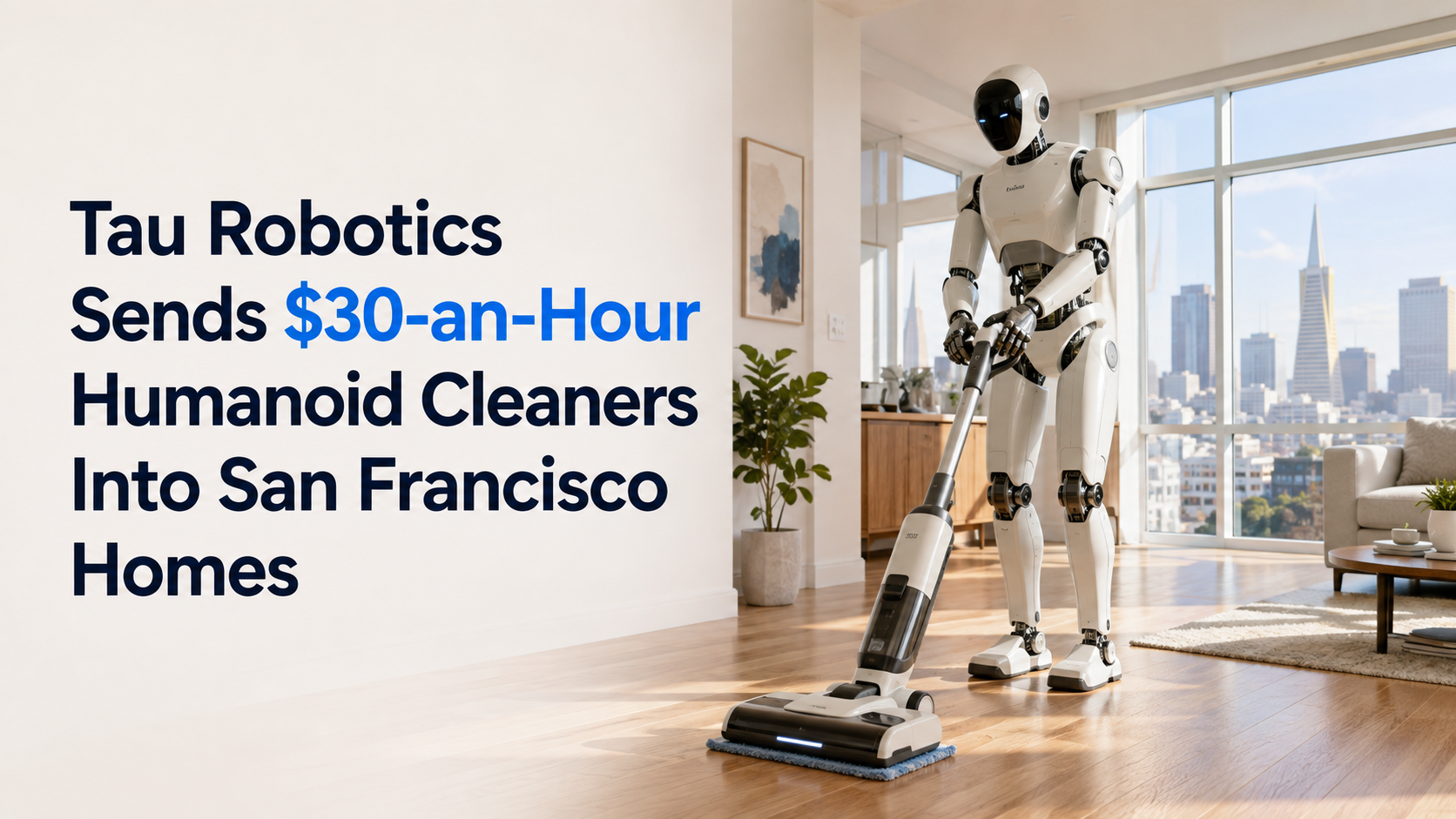
A San Francisco startup called Tau Robotics is now sending humanoid robots into private homes to vacuum floors, wipe counters and take out the trash, all for a flat rate of $30 an hour.
The pilot service, opened to a small pool of invited households in late July, is one of the first paid consumer deployments of general-purpose humanoid robots in the United States. It undercuts the local going rate for professional cleaners by roughly five to ten times.
How the $30 Service Works
Behind each machine sits a remote human operator who watches through the robot's cameras with a VR headset and steers it through anything the software cannot handle alone. Onboard AI keeps the routine mechanical work going.
Tau builds each robot at a reported cost of roughly $50,000. The company aims to reach around 1,000 cleanings a week in San Francisco by 2027, before opening the service to other U.S. markets in 2028.
Chief executive and co-founder Alex Koch has described the teleoperation model as a stepping stone to full autonomy rather than a permanent design.
"Initially they will be trained to imitate human performance, and then they will be trained to exceed human performance."
Koch made the remark in explaining how Tau plans to use footage from every teleoperated cleaning to train the next generation of models that will one day run the robots on their own.
What the Robots Actually Do
The startup has been unusually blunt about the limits of what its hardware can do today. The pilot's task list reads more like an appliance manual than an open-ended cleaning service.
Chores the robots take on in customer homes include:
- Vacuuming open floors
- Wiping down kitchen counters
- Unloading dishwashers
- Cleaning the interior of a refrigerator
- Taking bags of trash outside
The robots cannot climb stairs on their own and do not reliably know where to vacuum without direction. Adult supervision is required during every session, and Tau itself has described the machines as clumsy, heavy and prone to falling.
Picking up small objects from the floor and cleaning under furniture also remain out of reach, according to Koch, who has acknowledged the current hardware performs well only on basic tasks such as counter wiping.
A Deep Undercut on Human Cleaners
At $30 an hour, Tau's rate sits well below the $150 to $300 that Bay Area households typically pay for a professional cleaning visit.
Koch has argued the price gap opens the service to households that never hired a cleaner in the first place, framing the pilot as market expansion rather than a direct threat to the existing labor pool.
The economics only work today because Tau is subsidizing every visit. A robot that costs $50,000 to build, plus the wages of a remote operator, cannot break even at $30 an hour on cleaning gigs. The company is effectively paying to generate training data.
Robotics Researchers Urge Caution
Not everyone in the robotics community is convinced the hardware is ready for people's homes. Skeptics point to the gap between polished teleoperated demos and reliable autonomous work.
Ken Goldberg, an engineering professor at the University of California, Berkeley, told ABC News he doubts current humanoid robots can perform meaningful housework without a person on the other end of the link.
Goldberg said it is "too early" and that he would be "very surprised if these could do anything close to a useful job of cleaning a house" without heavy teleoperation propping them up.
Tau Joins a Crowded Humanoid Race
Tau's rollout arrives as a wave of humanoid manufacturers push beyond factory pilots into commercial deployments. The competition is now measured in weeks, not quarters.
Tesla is retooling its Fremont plant to build Optimus units, having torn down its Model S and Model X assembly line in about 46 days to free the floor space. Unitree Robotics debuted on the Shanghai STAR Market last week to a valuation above 400 billion yuan, a first for a mainland-listed humanoid maker.
Hugging Face and Pollen Robotics have taken a different route, launching a $399 open-source biped called Microduck aimed at researchers and hobbyists rather than paying customers.
Further Reading
What Tau is really selling, at least for now, is a data pipeline dressed up as a service. Every hour a robot spends in a customer's kitchen produces the kind of manipulation footage rival labs are paying handsomely to generate in staged environments.
Whether the model scales beyond a few hundred households in one city will depend less on the $30 price tag and more on whether the machines can eventually clean a stranger's bathroom without a human in a VR headset guiding every step.
