
OpenAI Unveils Jalapeño Chip to Supercharge AI Inference Efficiency
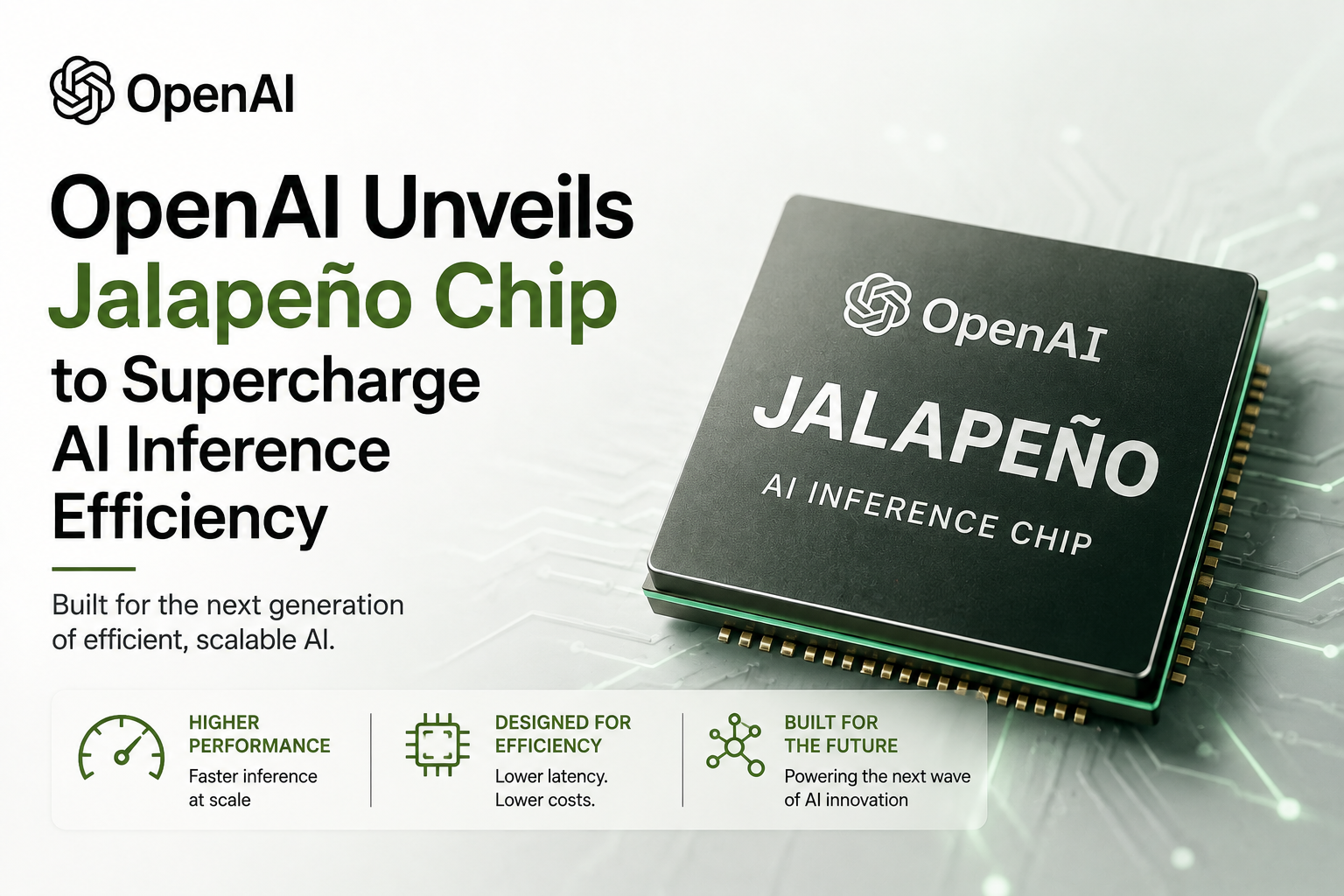
OpenAI has officially pulled back the curtain on its custom silicon strategy with the announcement of Jalapeño, a brand-new inference chip designed from the ground up to address the escalating computational demands of modern artificial intelligence models.
According to the company's technical disclosures, the processor delivers industry-leading speed and operational efficiency, slashing latency and boosting throughput significantly compared to standard off-the-shelf hardware alternatives.
As large language models and reasoning engines scale in parameter size and complexity, the bottleneck for enterprise deployments has increasingly shifted from raw training compute to the sheer cost and speed of real-time inference.
Jalapeño tackles this exact challenge by optimizing data movement and computational pathways specifically for generative AI workloads. By tailoring the silicon architecture directly to the execution profiles of its frontier models, OpenAI aims to squeeze maximum performance out of every watt consumed in its data centers.
This hardware milestone underscores a broader industry trend where top-tier AI labs are vertically integrating their tech stacks. Relying exclusively on general-purpose GPUs is no longer economically sustainable for companies serving billions of inference queries daily.
By building proprietary chips like Jalapeño, OpenAI is taking control of its infrastructure economics, creating a path toward cheaper, more abundant intelligence that can be passed down to developers and enterprise customers alike.
The arrival of custom silicon also signals intensifying competition in the AI hardware ecosystem, putting pressure on traditional chipmakers to innovate faster on inference efficiency.
While deployment details remain tightly managed, the successful rollout of Jalapeño could dramatically alter OpenAI's operational margins and reduce its heavy dependence on external hardware suppliers.
As the race for scalable AI infrastructure accelerates, specialized processors are rapidly becoming the ultimate differentiator for frontier labs.