
Sundar Pichai Responds to Claims Google Is Losing the AI Race
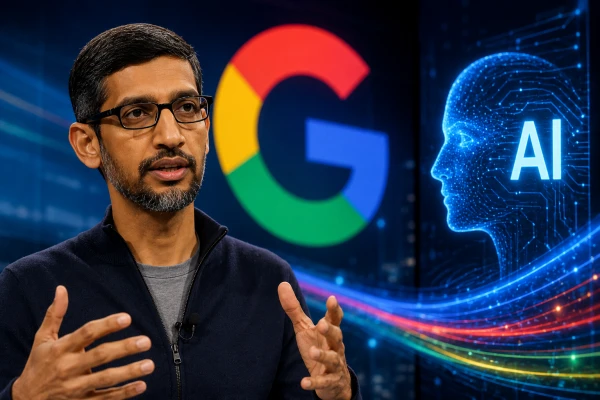
Google is facing some of the biggest questions in its history as competition in artificial intelligence continues to intensify. Following the rapid rise of ChatGPT, Claude and several other frontier AI models, investors and industry analysts have questioned whether Google is losing its long-held leadership in AI innovation.
During Alphabet's latest earnings discussion, Chief Executive Officer Sundar Pichai directly addressed those concerns, defending Google's strategy and insisting that the company remains one of the industry's leading artificial intelligence innovators despite delays affecting some of its most anticipated models.
Much of the discussion has centered on Gemini 3.5 Pro, Google's next-generation flagship AI model. Expectations were high that the model would strengthen Google's position in advanced reasoning, software development and autonomous AI agents.
However, its delayed release has led some analysts to question whether Google is moving too cautiously while competitors continue launching increasingly capable systems. Pichai acknowledged the intense pace of competition but argued that building powerful AI responsibly requires extensive testing and evaluation before public deployment.
Google's position in the AI market remains exceptionally strong despite these concerns. Through Google DeepMind, the company continues developing frontier AI models while integrating artificial intelligence across Search, Workspace, Android, Cloud and YouTube.
Gemini powers AI Overviews, coding assistants, productivity tools and developer services used by millions of businesses and consumers worldwide. Rather than relying on a single chatbot product, Google has embedded AI across nearly every major service it operates, making artificial intelligence a core part of its long-term business strategy.
Competition has become more intense than ever. OpenAI continues expanding ChatGPT with new reasoning capabilities, Anthropic is attracting enterprise customers through Claude, Microsoft is integrating AI throughout Windows and Microsoft 365, while Meta and several Chinese AI companies are rapidly improving their own models.
This fast-moving environment means every model launch is closely examined by investors looking for signs of leadership or weakness. A delayed release can quickly generate headlines suggesting a company is falling behind, even if its underlying research remains highly competitive.
Pichai rejected the idea that Google has lost momentum. He pointed to the company's extensive investments in custom AI hardware, large-scale data centers and research talent as evidence that Google is positioned for long-term success.
Alphabet continues spending billions of dollars expanding the infrastructure required to train increasingly sophisticated AI models. These investments include advanced Tensor Processing Units (TPUs), cloud computing capacity and global networking systems that support AI services across Google's ecosystem.
Another important factor is Google's emphasis on balancing capability with responsibility. As AI systems become more autonomous, companies face growing pressure to ensure models are safe, reliable and resistant to misuse.
Google has consistently argued that rigorous testing before release helps reduce potential risks while improving the quality of the final product. Although this approach may slow some launches, the company believes it builds greater trust among businesses, governments and consumers adopting AI at scale.
Developers are also watching closely because Gemini plays an increasingly important role in software engineering and enterprise applications. Businesses rely on Google's AI services for document analysis, coding assistance, cloud automation and customer support.
Improvements to Gemini therefore have implications far beyond consumer chatbots, influencing productivity across industries ranging from healthcare and finance to education and manufacturing.
The broader AI race is no longer defined solely by benchmark scores. Companies are competing across multiple fronts, including reasoning ability, coding performance, infrastructure, security, operating costs and enterprise adoption.
Success increasingly depends on delivering reliable AI systems that organizations can trust rather than simply releasing the most powerful model first. This shift explains why Google continues investing heavily in research, infrastructure and safety alongside model development.
Sundar Pichai's response reflects the reality of today's AI industry: competition has never been stronger, expectations have never been higher and every major release is judged against rapidly evolving rivals. Whether Gemini 3.5 Pro ultimately changes perceptions will depend on its real-world performance after launch, but Google's message is clear.
The company believes it remains fully committed to leading the next generation of artificial intelligence, even if that means taking more time to deliver technology it considers ready for global deployment.
