
Why Small Businesses Are Becoming the Biggest Winners of the AI Revolution
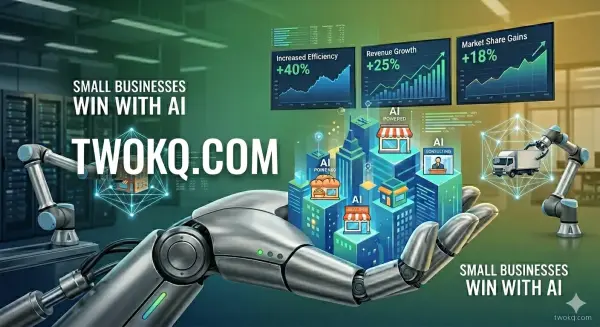
Why Small Businesses Are Becoming the Biggest Winners of the AI Revolution
For years, artificial intelligence was viewed as a technology reserved for large corporations with deep pockets, extensive data resources, and teams of specialized engineers.
Building and deploying advanced AI systems required significant investment, putting the technology out of reach for most small and medium-sized businesses.
That reality is changing rapidly.
The latest wave of AI tools is making sophisticated capabilities accessible to businesses of all sizes. From customer support and marketing to accounting and inventory management, artificial intelligence is helping smaller companies operate with a level of efficiency that was once only available to enterprise organizations.
As the technology becomes easier to adopt and more affordable to use, many small businesses are discovering that AI may be one of the most important competitive advantages available today.
The traditional challenge for smaller companies has always been resources. Unlike larger organizations, they often operate with limited budgets, lean teams, and less time to devote to repetitive administrative work.
Artificial intelligence is helping to close that gap.
Tasks that once required hours of manual effort can now be completed in minutes. Business owners can generate marketing content, analyze customer behavior, automate appointment scheduling, manage inventory forecasts, and respond to customer inquiries without hiring additional staff.
This shift allows entrepreneurs to focus more attention on strategic growth rather than daily operational bottlenecks.
Customer expectations have also changed dramatically. Consumers increasingly expect fast responses, personalized experiences, and seamless interactions regardless of the size of a company.
Meeting those expectations used to require substantial investments in customer service infrastructure. Today, AI-powered systems can help smaller businesses deliver responsive support around the clock.
Modern AI tools can answer common questions, guide customers through purchasing decisions, and provide support outside traditional business hours. While human interaction remains essential for complex issues, AI allows businesses to maintain a consistent level of service without significantly increasing costs.
Marketing is another area undergoing significant transformation.
Small businesses have traditionally struggled to compete with larger competitors that could afford dedicated marketing departments and extensive advertising budgets. Artificial intelligence is helping level the playing field.
AI-powered platforms can identify audience trends, generate content ideas, optimize advertising campaigns, and analyze performance metrics in real time. Instead of relying on guesswork, business owners can make data-driven decisions that improve marketing efficiency and maximize return on investment.
The impact extends beyond customer-facing operations.
Financial management, inventory planning, and internal productivity are increasingly benefiting from AI-driven insights. Predictive analytics tools can identify seasonal trends, forecast demand, and highlight operational inefficiencies before they become costly problems.
For businesses operating in highly competitive markets, these insights can provide a meaningful advantage.
Despite the benefits, successful adoption requires a thoughtful approach.
Many organizations make the mistake of pursuing AI simply because it is popular. The most successful businesses begin by identifying specific challenges that can be solved through automation or data analysis. Rather than attempting to transform every aspect of operations at once, they focus on practical use cases that deliver measurable value.
Training employees is equally important. Technology alone does not create better outcomes. Businesses that invest in helping their teams understand and effectively use AI tools are more likely to achieve sustainable results.
Concerns around privacy, security, and accuracy also remain important considerations. Companies should evaluate vendors carefully, understand how data is processed, and establish clear guidelines for responsible use.
The future of artificial intelligence will not be defined solely by large technology companies.
Many of the most significant gains may come from millions of smaller businesses that use AI to streamline operations, improve customer experiences, and compete more effectively in their markets.
The democratization of artificial intelligence is creating opportunities that were unimaginable just a few years ago. Businesses that embrace these tools strategically are positioning themselves to grow faster, operate more efficiently, and remain competitive in an increasingly digital economy.
For small businesses willing to adapt, the AI revolution is not a threat. It is an opportunity.