
OpenAI's First AI Device: Everything We Know About Sam Altman and Jony Ive's Secret Project
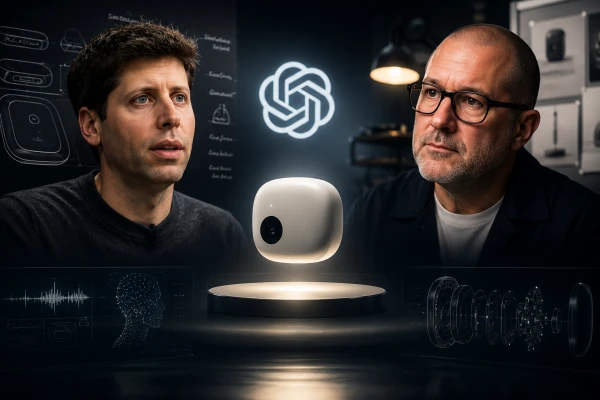
OpenAI is preparing to enter a completely new market. After transforming artificial intelligence with ChatGPT, the company is now developing its first dedicated AI hardware product in partnership with legendary designer Jony Ive, the former Apple executive responsible for iconic products including the iPhone, iPad and MacBook.
While OpenAI has not officially revealed the final design, multiple reports suggest the company is building a completely new category of AI device designed around natural conversation rather than traditional smartphone apps.
The project has attracted enormous attention because it represents OpenAI's biggest expansion beyond software. ChatGPT already serves hundreds of millions of users through web browsers and mobile applications, but dedicated hardware could allow AI to become a constant companion throughout the day.
Industry observers believe the device is being designed to understand voice, context and user intent in real time, allowing people to interact with artificial intelligence without repeatedly opening apps or typing prompts.
Unlike smartphones, which require users to navigate menus and applications, OpenAI's new hardware is expected to focus on conversation-first computing. Instead of launching individual apps for email, scheduling, research or navigation, users may simply ask the AI to complete complex tasks across multiple services automatically. This approach reflects a growing industry trend toward AI agents that can perform work rather than simply answer questions.
The involvement of Jony Ive has generated particular excitement. During his time at Apple, Ive helped define the design of some of the most successful consumer electronics ever produced.
His collaboration with Sam Altman has fueled speculation that OpenAI intends to create a completely new product category rather than simply competing with existing smartphones. Although the company has not confirmed the device's appearance, reports suggest it may feature a minimalist design with heavy emphasis on voice interaction and contextual intelligence.
Behind the hardware lies OpenAI's latest AI technology. The device is expected to rely on advanced GPT models capable of understanding natural language, planning multi-step tasks and interacting with online services.
As AI models become more capable, dedicated hardware could provide faster responses, improved personalization and deeper integration with users' daily routines. Analysts believe future versions may also support visual recognition, live translation and intelligent automation for both consumers and businesses.
Competition in AI hardware is becoming increasingly intense. Companies including Apple, Google, Meta and several startups are investing heavily in devices designed specifically for artificial intelligence.
However, OpenAI enters the market with one of the world's most recognizable AI brands and a rapidly growing ecosystem of developers and enterprise customers. If the company successfully combines powerful AI software with innovative hardware, it could reshape expectations for personal computing in much the same way smartphones did more than a decade ago.
Businesses are also paying close attention. A dedicated AI device could improve productivity by helping professionals manage meetings, summarize documents, generate reports, answer customer questions and automate repetitive tasks without switching between multiple applications. Developers may also gain access to new tools that allow them to build AI-powered experiences specifically optimized for OpenAI's hardware platform.
Although OpenAI has not announced an official release date, interest continues to grow as new details emerge. Industry analysts expect additional announcements over the coming months, making this one of the most closely watched technology projects in the artificial intelligence industry. If successful, OpenAI's first hardware product could mark the beginning of a new era where AI is no longer confined to screens but becomes a seamless part of everyday life.