
Nvidia PAIR Turns Idle PCs Into a Local AI Cluster
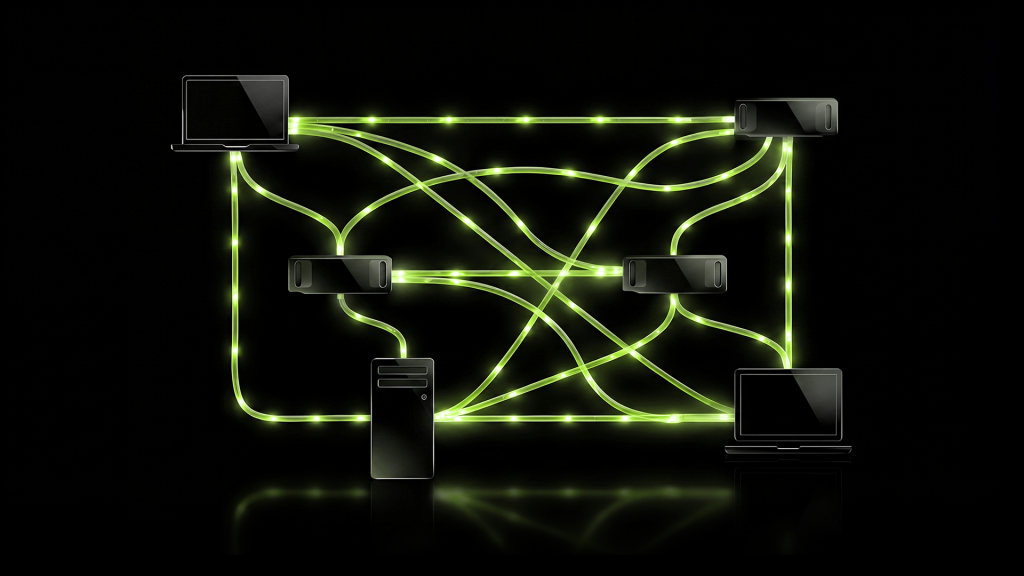
Nvidia PAIR turns idle PCs into a local AI cluster by routing independent model requests across compatible computers on the same network. The free, open-source Personal AI Router beta targets a growing bottleneck: local agents that create many parallel jobs but send every one of them to a single overloaded machine.
The software launched on September 3 for Windows, macOS and Linux. It supports Nvidia GeForce RTX 20 Series and newer GPUs, RTX PRO workstations, DGX Spark systems and Apple computers with M4 or newer silicon, while working with the widely used Ollama and LM Studio inference engines.
How Nvidia PAIR Routes Work
PAIR sits between an AI application and the computers available on a private network. It exposes familiar Ollama-compatible and OpenAI-compatible endpoints, then selects an eligible machine according to model availability, engine state and current workload.
Each request runs from start to finish on one node. PAIR does not merge GPU memory, split a single model across computers or turn several graphics cards into one larger logical accelerator, a limitation that separates it from conventional distributed-training and model-sharding systems.
The router evaluates several conditions before assigning new work:
- Whether a paired computer is online and ready
- Whether Ollama or LM Studio is running on that node
- Whether the requested model is already available there
- How many jobs are active on the node and engine
- Whether another application is heavily using the GPU
That design suits multi-agent systems, where a lead agent may divide research, coding or organization work among several subagents. Independent model calls can run at the same time on different machines instead of forming one queue behind a single GPU.
Three Devices Cut Demo Time
Nvidia demonstrated PAIR with Hermes Desktop, Ollama and five subagents. A three-device cluster completed the workload in 8 minutes 48 seconds, compared with 18 minutes on one RTX Spark laptop, according to the company's technical blog.
The result is a vendor demonstration rather than an independent benchmark. Performance will depend on network conditions, whether every node has the same model, the speed and memory of each computer, and whether the workload contains enough independent requests to run concurrently.
PAIR is designed for changing household conditions rather than permanently available servers. A gaming PC can leave the pool when its GPU becomes busy, a laptop can sleep or disconnect, and an available workstation can accept new jobs without forcing the application to change endpoints.
Local Privacy Has Conditions
Nvidia says prompts, responses and inference traffic are intended to stay on the local network when clients, engines, models and nodes are all configured locally. Devices discover one another through mDNS, pair with a six-digit code and use mutual TLS encryption for traffic between services.
Local routing does not automatically guarantee that every application is private. A model downloader, agent plug-in or other connected service may still contact the internet, so users must inspect the full software chain rather than treating PAIR itself as a blanket privacy control.
The beta uses signed installers for Windows, a Debian package for Linux and a disk image for macOS. Nvidia recommends the desktop application for most users, though it also provides a terminal interface and source-build path for headless machines and developers modifying the project.
Mixed clusters can include Windows, Linux and macOS nodes. Engine and model compatibility still apply individually: installing PAIR on a machine does not guarantee that Ollama, LM Studio or a selected model can run within that machine's memory and driver limits.
Local Agents Gain Infrastructure
PAIR arrives as agent software increasingly fans one assignment into multiple model calls. Nvidia also announced simpler Windows setup for Hermes Agent, OpenClaw and Perplexity Portable Computer, positioning the router as infrastructure for a broader local-agent push rather than a standalone consumer utility.
The project is licensed under Apache 2.0 and hosted publicly on GitHub. Compatibility with established local inference interfaces may be its strongest adoption advantage because agent developers do not need to build a new clustering integration before taking advantage of another computer.
The technical boundary is equally important. PAIR expands throughput for parallel jobs but cannot make an oversized model fit by combining memory across machines, so buyers should not mistake a household router for a replacement for a high-memory workstation or dedicated data-center cluster.
Further Reading
The early question is whether households and small teams have enough compatible hardware running the same local models to justify another coordination layer. For users already operating several AI-capable systems, however, the beta offers a practical way to reclaim capacity that would otherwise sit unused.
Independent tests will need to examine scheduling overhead, recovery when nodes disappear and security across mixed operating systems. If those results hold up, Nvidia PAIR could make local multi-agent workloads more responsive without pushing private tasks to a cloud service.