
FBI Arrests Former OpenAI Engineer Over Hidden Recording Device
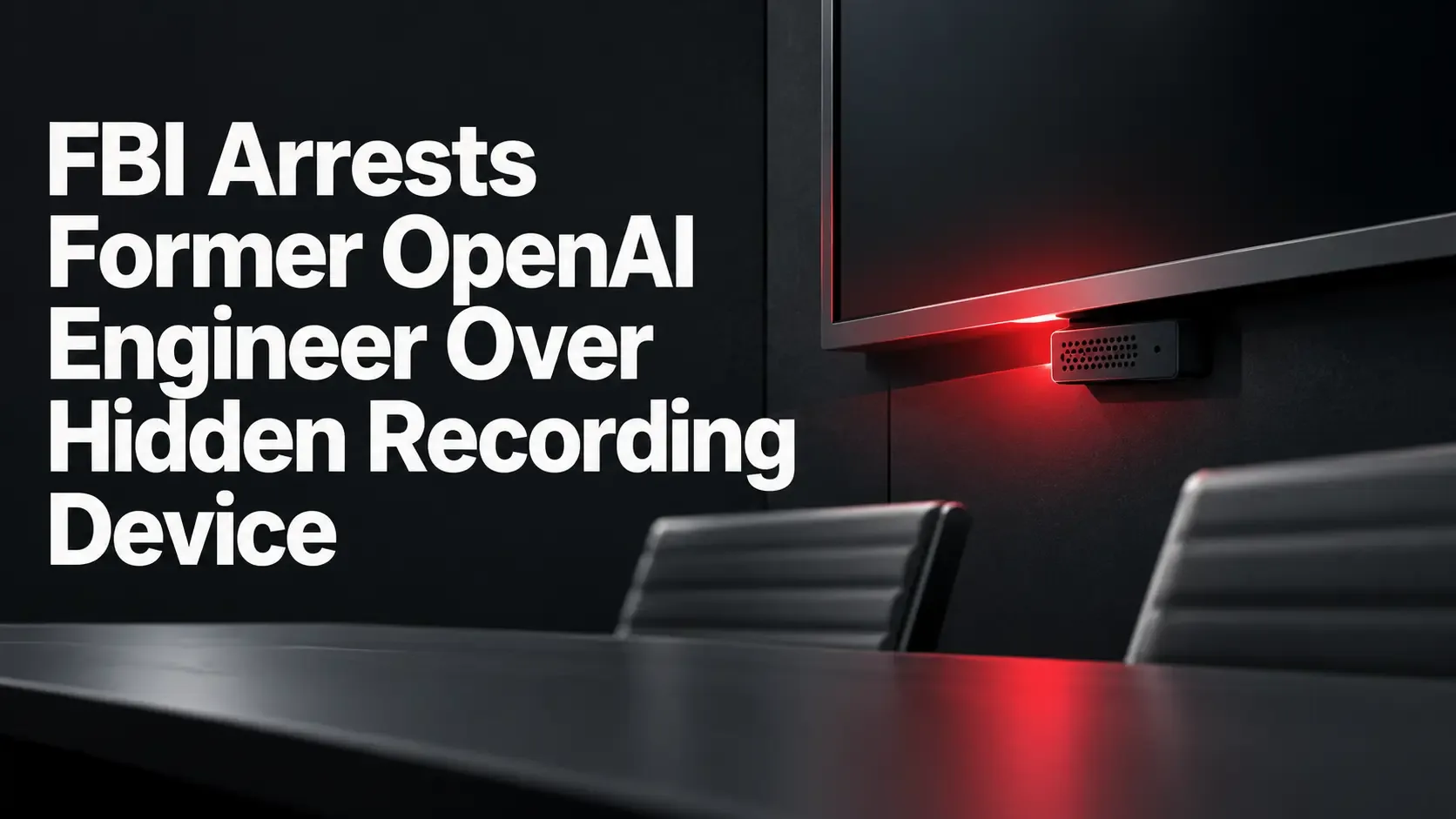
FBI arrests former OpenAI engineer Abdulrahman Alfozan after prosecutors alleged that he installed a hidden audio recorder in an executive conference room at the company’s San Francisco offices. The 35-year-old Saudi national was arrested on October 9 and appeared in federal court on October 13.
The criminal complaint does not establish a motive or prove that confidential information was captured. OpenAI said it found no indication that model weights, source code or customer data were improperly accessed or removed, and federal law presumes Alfozan innocent unless prosecutors prove the charge beyond a reasonable doubt.
The public record establishes four central facts:
- OpenAI found the device during a September 30 security sweep.
- The FBI arrested Alfozan nine days later.
- Prosecutors charged him under the federal wiretap law.
- No theft of model weights, code or customer data has been identified.
FBI Arrests Former OpenAI Engineer After Conference-Room Discovery
The U.S. Attorney’s Office for the Northern District of California said Alfozan had worked at OpenAI since July 2025. Its October 13 announcement followed the unsealing of a complaint charging him with using or endeavoring to use an electronic device to intercept oral communications.
OpenAI personnel discovered the recorder connected to a USB port behind a television in an executive conference room. The Justice Department said the device had been concealed in toilet paper, installed around September 28 and configured with encrypted storage.
The room was used for meetings involving proprietary research, product plans, business-development opportunities, government engagements and strategic decisions, according to the complaint. Prosecutors allege Alfozan was not authorized to enter the room or participate in its meetings.
Alfozan remains in federal custody, and a detention hearing is scheduled for October 19 before U.S. Magistrate Judge Alex G. Tse. The single charged offense carries a statutory maximum of five years in prison, a $250,000 fine and three years of supervised release if he is convicted.
What the Federal Complaint Alleges
The complaint describes a trail built from office-access records, closed-circuit video, internal searches and chatbot activity. It alleges that Alfozan appeared near the executive conference room on several dates before the device was found and later entered the room on October 5 to look behind the television.
Investigators also cited searches made through a workplace productivity tool for building addresses, meeting-room capacities, calendars and the locations of leadership or external-partner meetings. Those searches are evidence cited by prosecutors, not an independent finding about what Alfozan intended.
A chatbot account associated with Alfozan’s spouse allegedly submitted prompts about building and concealing a continuous audio recorder, adding Wi-Fi connectivity, improving live listening and encrypting an SD card. The complaint says the account also referenced the discovered device’s custom header and unique network identifier.
OpenAI security personnel found a second, similar device inside Alfozan’s unattended bag on October 5, along with his wallet and identification, the filing alleges. Four days later, the FBI arrested him. Reuters reported that it was not immediately clear who represented him, and an email associated with his name received no response.
OpenAI Says Its Models Helped Trace the Device
OpenAI said its internal AI systems helped investigators understand the device and trace its origin to a specific employee. The company also said it had evidence that additional recording devices were intended for other sensitive office locations, terminated the employee and referred the matter to the FBI.
The company’s account places an unusual AI element inside a conventional physical-security investigation. Internal models can accelerate analysis of device components, search activity and access patterns, but those outputs still require corroboration through logs, video, physical evidence and human review.
OpenAI’s statement sharply limits what is currently known about information exposure. It said there was no indication Alfozan had improperly accessed or exfiltrated model weights, source code or customer data. The encrypted contents of the conference-room device were inaccessible when described in the complaint.
That distinction matters because senior Justice Department and FBI officials framed the investigation as a national-security and counterintelligence priority. Their statements describe the sensitivity of American AI research, but neither the complaint nor the company’s disclosure identifies a foreign recipient or establishes an espionage motive.
The Arrest Expands the Security Perimeter Around AI Labs
Frontier AI companies have concentrated valuable model research, computing strategies, government relationships and commercial plans inside a relatively small number of offices. That makes internal rooms, visitor controls and ordinary workplace devices part of the same security perimeter as repositories, credentials and model-weight storage.
The alleged use of workplace search tools and a chatbot also raises a monitoring problem. Companies need ways to detect patterns that may indicate preparations for abuse without treating routine employee research as proof of misconduct or turning every internal AI interaction into unrestricted surveillance.
A defensible approach combines narrowly scoped access, documented retention rules, human review and escalation based on multiple signals. Physical sweeps, room-level permissions and hardware inventories remain essential because a sophisticated digital security program cannot prevent a microphone from capturing an unprotected conversation.
The next public milestone is the October 19 detention hearing. Beyond that, prosecutors must prove the charged conduct in court, and further filings may clarify whether any audio was recovered, why the device was allegedly installed and whether additional charges are contemplated.
Further Reading