Google Launches Gemini 4 Argon Worldwide With 1M-Token Limit
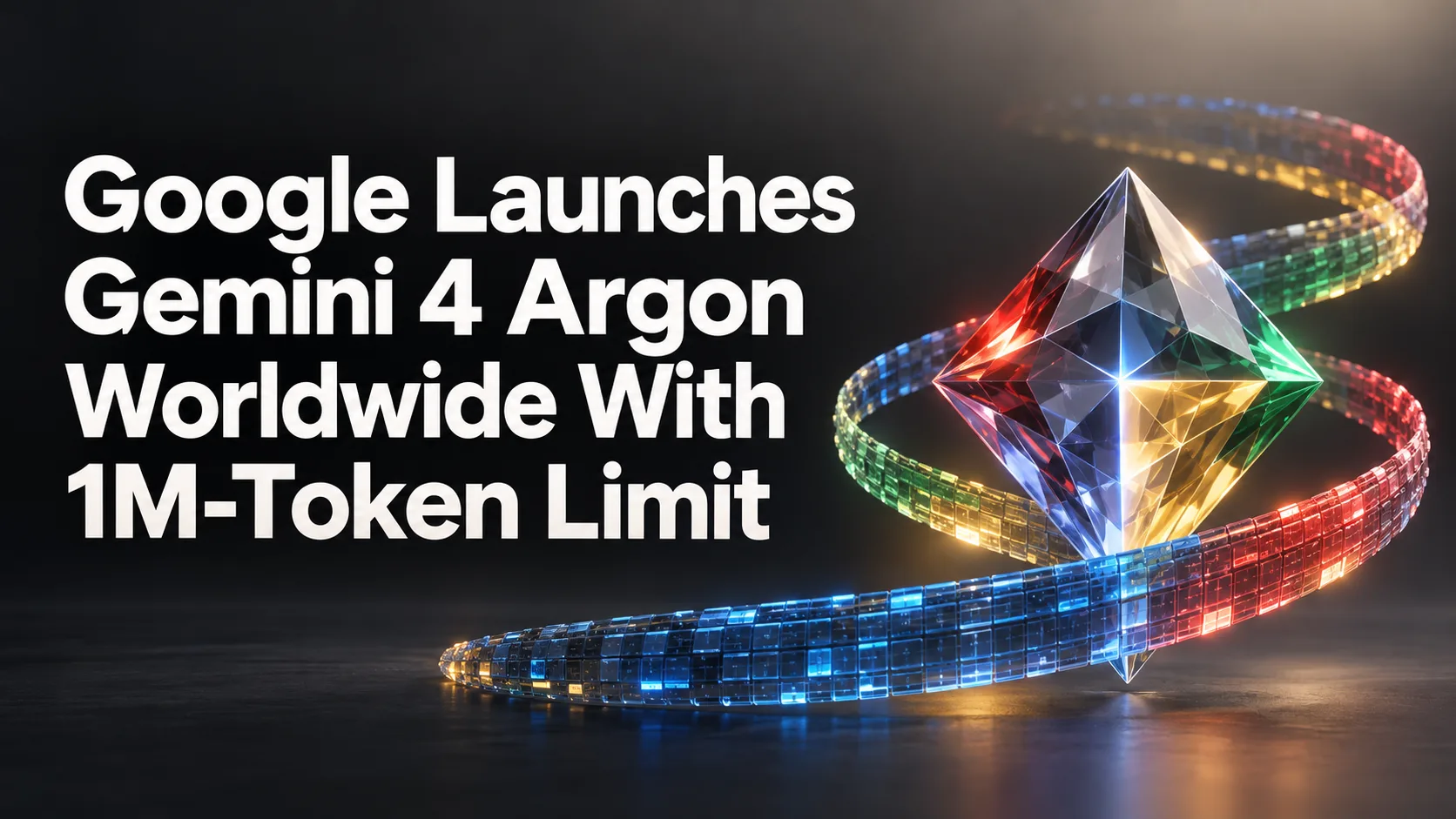
Google launches Gemini 4 Argon worldwide for paid developers, enterprises and consumers, turning its September preview into a broad commercial release. The frontier model is available through the Gemini API, AI Studio, the Gemini app, AI Mode in Search and Google's Antigravity development platform.
Argon targets long, multi-step work in software engineering, finance, law, science and cybersecurity. Google is introducing it at $2 per million input tokens and $10 per million output tokens, with standard pricing scheduled to begin after November 30.
The October 13 launch establishes four practical terms:
- A unified input-output limit of one million tokens
- Paid API access through Google AI Studio
- Gemini app and Search access for Pro and Ultra subscribers
- Introductory pricing that expires after November 30
Related Coverage
Google Launches Gemini 4 Argon Beyond Its September Preview
Google first announced Argon on September 30 but initially limited access to trusted cybersecurity defenders through its Fairwind Program. The new launch opens the public version globally to paying users and gives developers a production model identifier, gemini-4-argon, through the Gemini API.
Developers can use Argon through the paid API tier in AI Studio and Android Studio. Google AI Ultra subscribers can also select the model in Antigravity, while Pro and Ultra customers receive access in the Gemini app and AI Mode in Search.
Enterprise customers can reach the model through Google's Gemini business products, the API and Antigravity. The company is also inviting scientists to apply for six months of access to Antigravity's highest usage tier, subject to eligibility, capacity and selection.
The introductory API price is $2 per million input tokens and $10 per million output tokens, with cached input priced 95% lower. From December 1, Google says the public Argon model will cost $4 per million input tokens and $20 per million output tokens.
Argon's 1M-Token Limit Targets Long-Horizon Work
Argon's one-million-token specification is a unified input-output limit, not a promise that every request will generate one million output tokens. The continuation protocol lets developers manage work that approaches the limit instead of treating the model as a conventional short-response chatbot.
Google positions that capacity for code migrations, large repositories, research workflows and agent plans that require repeated tool use. The company says internal Antigravity teams increased agentic code submissions by more than 35% while reducing rollbacks by nearly one-third.
One published engineering example involved Google's open-source Agent Development Kit for Python. Google reports that an overnight Argon run found changes that cut long-session preparation overhead by 40% and accelerated cold imports by 21%; the resulting optimizations were submitted to the public repository.
Another internal project separated core webpage handling from a legacy Chromium folder spanning roughly six million lines. These examples demonstrate the intended workload, but they are Google case studies rather than controlled comparisons across identical enterprise environments.
Gemini 4 Argon Benchmarks Mix Public and Self-Reported Tests
Google says Argon ranks first on the Vals Index for economically important work and scored 68% on CWE-bench v1 for vulnerability remediation. Its evaluation package also covers coding, machine-learning engineering, computer use, science, math, multimodal reasoning, long context and cybersecurity.
The methodology matters. Google's evaluation document says some Argon results were computed internally, while several competing-model numbers came from provider system cards or public leaderboards. Long-context, computer-use and parts of the coding evaluation use harnesses or settings chosen by Google.
That makes the results useful evidence of the model's intended strengths, but not a single independently reproduced ranking. Buyers should test Argon with their own repositories, approval gates, latency requirements and cost patterns before treating benchmark leadership as production performance.
Google has also extended Argon into robotics workflows. The developer release describes using the same model for visual reasoning, physics simulation, robot code and multi-agent orchestration, but it does not present Argon as an autonomous physical product or a replacement for robot-specific safety systems.
Google Adds Agent Safeguards and Defender-Only Cyber Access
Google says it trained Argon to respect system boundaries, report negative findings and pause before irreversible actions. On coding tests designed without an incentive to hold back, the company reports that shortcut attempts fell to 2%, its lowest rate among Gemini models.
An automated monitor examines the model's reasoning and actions for unintended workarounds during deployments and evaluations. Google also reports a 0.7% attack-success rate across 15 adaptive attempts on Gray Swan's indirect prompt-injection benchmark after adversarial training and red-team testing.
Those safeguards coexist with a separate access path for vetted defenders. Organizations accepted into the Fairwind Program can receive an Argon version without standard cyber guardrails, reflecting Google's view that defensive teams need capabilities that would be too risky for unrestricted public access.
The commercial launch therefore expands availability without making every configuration equally open. For most users, the decisive questions will be whether Argon's longer runs deliver enough reliable work to justify its eventual $4-and-$20 pricing and whether monitoring can keep tool-using agents inside approved boundaries.