
Claude AI Public Chats Are Appearing in Google Search: What Happened and How to Protect Your Privacy
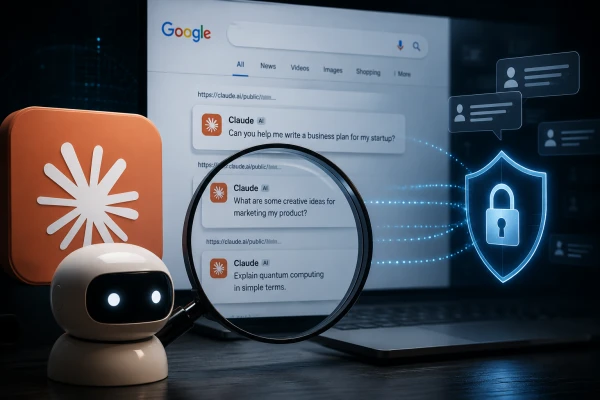
Artificial intelligence has made sharing documents, code, websites and creative projects easier than ever, but a new discovery involving Anthropic's Claude AI has highlighted how quickly convenience can become a privacy concern. Users recently discovered that some content they created with Claude and shared using public links was appearing in Google Search results.
The discovery quickly spread across Reddit and X, surprising many people who believed their AI-generated work would remain visible only to those who received the direct link. Anthropic has clarified that Claude conversations are private by default, but content intentionally shared through public links can be indexed by search engines just like any other public webpage.
The issue involves Claude's sharing feature rather than a security breach. When users generate a public link to share a document, webpage or other creation, that link becomes accessible on the open web unless additional restrictions are applied. Search engines such as Google can discover and index those pages over time if they are publicly reachable.
This means the content may appear in search results even if the creator did not expect it to be widely discoverable. Anthropic says it does not publish directories or sitemaps of user content, but public URLs remain eligible for indexing by search engines.
The incident has renewed discussions about digital privacy in the age of generative AI. Many users treat AI assistants as personal workspaces where they draft business plans, write reports, build software prototypes or organize sensitive notes.
If those materials are later shared through public links without fully understanding how web indexing works, confidential information could become easier to find than intended. Privacy experts say the situation serves as a reminder that "public" on the internet often means discoverable by anyone, including search engines.
For businesses, the news is especially important. Companies increasingly use AI assistants to prepare internal documentation, marketing strategies, software specifications and customer communications.
Accidentally exposing internal material through publicly shared AI links could create reputational, legal or competitive risks. Organizations adopting AI tools should review how employees share AI-generated content and establish clear policies for handling confidential information.
The situation also reflects a broader challenge facing AI companies. As artificial intelligence platforms evolve into complete productivity environments, they must balance seamless collaboration with strong privacy protections.
Users expect sharing to be simple, but they also expect clear warnings about what becomes public and how search engines may treat shared content. Better transparency around visibility settings is likely to become a priority across the AI industry.
Anthropic has encouraged users to review the visibility of their shared content and remove public links that are no longer needed. People working with sensitive business documents, research materials or personal information should confirm that anything intended to remain private has not been shared publicly. Taking a few moments to review these settings can significantly reduce the risk of unintended exposure.
The discovery comes at a time when competition between AI platforms is intensifying. OpenAI, Google, Anthropic and other developers are rapidly adding collaboration features that allow users to share AI-generated documents, applications and websites with others.
As these capabilities become more common, questions about indexing, privacy and user control are likely to become just as important as model performance or benchmark scores.
Although Anthropic says the behavior is consistent with how public links work across the web, the episode has become a valuable reminder that AI-generated content follows many of the same rules as traditional websites.
Before sharing anything publicly, users should carefully consider whether they are comfortable with that content potentially appearing in search results. As AI becomes more deeply integrated into everyday work, understanding these privacy settings will be an essential part of using generative AI safely and responsibly.
