
Best AI Coding Tools in 2026: Top AI Assistants Every Developer Should Try
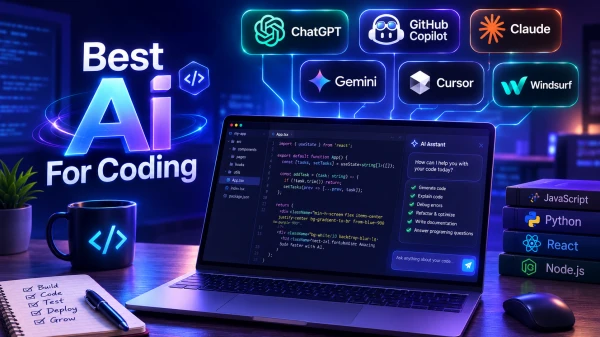
Artificial intelligence has become an essential part of modern software development, helping programmers write code faster, identify bugs more efficiently and automate repetitive tasks that once consumed hours of work.
Whether you're a beginner learning your first programming language or an experienced software engineer building enterprise applications, AI coding assistants can significantly improve productivity. In 2026, competition among AI coding platforms has intensified, giving developers more choices than ever before.
From conversational programming assistants to intelligent integrated development environments, today's AI tools are transforming the way software is designed, tested and deployed.
One of the most widely used coding assistants remains ChatGPT. Developers rely on ChatGPT for explaining complex programming concepts, generating code in multiple languages, debugging errors, writing documentation and learning unfamiliar frameworks.
Its conversational interface makes it particularly valuable because programmers can ask follow-up questions, refine generated code and receive detailed explanations instead of simply copying solutions. Many developers also use ChatGPT to plan software architecture, generate SQL queries, optimize algorithms and translate code between programming languages.
Another leading option is GitHub Copilot, which integrates directly into popular code editors and provides real-time code suggestions while developers type. Instead of leaving the editor to ask questions, programmers receive intelligent autocomplete recommendations, function implementations and boilerplate code inside their development environment. This seamless workflow has made Copilot one of the most popular AI tools for professional software engineers working on large projects.
Claude has gained a strong reputation among developers who frequently work with large codebases and technical documentation. Many users appreciate its ability to analyze long files, explain architecture decisions and maintain context across extended programming discussions. This makes Claude particularly useful for reviewing existing projects, understanding unfamiliar code and planning software improvements before implementation.
Google's Gemini continues improving its developer-focused capabilities through deep integration with Google's cloud ecosystem. Developers building Android applications, web services and cloud infrastructure often use Gemini alongside Google Cloud tools, enabling AI-assisted programming within Google's broader development platform. Gemini's multimodal capabilities also allow it to interpret screenshots, diagrams and technical documentation while assisting with software development.
Specialized AI development environments have also become increasingly popular. Cursor has emerged as one of the fastest-growing AI-powered code editors by embedding advanced conversational AI directly into the programming workflow. Developers can edit files, refactor code, generate new features and receive intelligent explanations without constantly switching between applications.
Similarly, Windsurf focuses on AI-assisted development by combining intelligent code generation with project-wide understanding, helping teams move from ideas to working software more quickly.
Choosing the right AI coding assistant depends largely on individual workflows and project requirements. Developers seeking conversational explanations often prefer ChatGPT, while those wanting continuous in-editor suggestions may choose GitHub Copilot.
Teams working with extensive documentation sometimes favor Claude, whereas organizations invested in Google's ecosystem frequently benefit from Gemini. AI-powered editors like Cursor and Windsurf appeal to developers who want artificial intelligence integrated directly into every stage of software development.
Artificial intelligence is no longer replacing programmers—it is becoming an increasingly capable collaborator. The best AI coding tools reduce repetitive work, improve code quality, accelerate learning and allow developers to spend more time solving complex engineering problems.
As AI models continue advancing, coding assistants are expected to become even more accurate, context-aware and deeply integrated into professional development environments. For anyone writing software in 2026, adopting an AI coding assistant is rapidly becoming less of an advantage and more of a standard part of modern programming.