
AI Robot Learns to Fold Clothes in Any Home Without Training, Marking a Major Breakthrough in Household Robotics
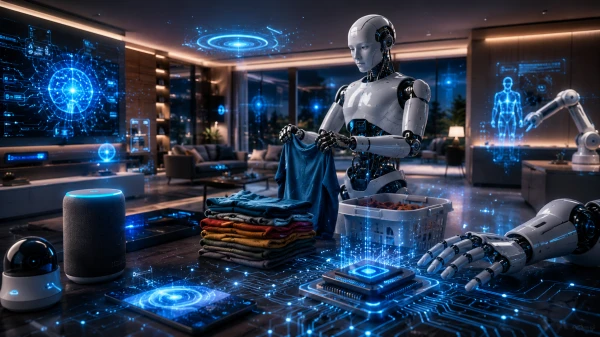
Artificial intelligence has already transformed how people search for information, generate content, write software, and automate business operations, but one of the biggest challenges has remained inside the home. While robotic vacuum cleaners and automated appliances have become common in millions of households, building a robot capable of performing everyday chores with the same flexibility as a human has proven far more difficult.
That challenge may now be moving closer to a solution after researchers introduced an artificial intelligence system that enables a household robot to fold clothes it has never encountered before, inside homes it has never visited, without requiring additional training.
The achievement represents one of the most significant advances in domestic robotics this year and demonstrates how rapidly AI is evolving beyond digital assistants into machines capable of interacting with the physical world.
Unlike many previous household robots that require carefully controlled environments or extensive retraining whenever conditions change, the new AI system has been designed to adapt naturally to unfamiliar surroundings. Whether the robot encounters different types of clothing, new furniture layouts, varying lighting conditions, or completely different homes, it can continue performing its task with an impressive level of accuracy.
According to the developers, the robot successfully folded unfamiliar clothing with a reported success rate exceeding 99 percent during testing. This level of adaptability has long been considered one of the biggest obstacles preventing robots from becoming practical assistants in everyday households, where no two environments are exactly alike.
The breakthrough is powered by a new artificial intelligence model capable of transferring knowledge from previous experiences instead of memorizing only specific situations. Traditional robots often rely on fixed programming that tells them exactly how to perform a task under predetermined conditions. If a new object, different room layout, or unexpected obstacle appears, the robot frequently becomes confused or requires manual intervention.
Modern AI systems are changing this approach by allowing robots to understand patterns, recognize new situations, and make intelligent decisions without needing engineers to rewrite software for every possible scenario. This capability moves robotics significantly closer to the way humans naturally learn and adapt throughout everyday life.
Researchers also developed an innovative training process that combines demonstrations from human operators with continuous real-world learning. Instead of relying entirely on computer simulations, the robot observes human movements through specialized sensor technology before refining its own abilities through repeated practice. Every successful attempt improves future performance, allowing the system to become more efficient over time.
This approach dramatically reduces the amount of manual programming traditionally required while making it easier to teach robots additional household tasks in the future. Engineers believe the same learning methods could eventually be applied to activities such as organizing rooms, loading dishwashers, preparing simple meals, cleaning kitchens, assisting elderly people, and supporting individuals with physical disabilities.
The announcement reflects a much broader transformation taking place across the global robotics industry. Artificial intelligence is rapidly expanding beyond software applications into machines capable of interacting with physical environments. Technology companies around the world are investing billions of dollars into humanoid robots designed for factories, hospitals, warehouses, hotels, retail stores, agriculture, logistics, and eventually private homes.
Improvements in AI reasoning, computer vision, motion planning, and advanced sensors are making robots increasingly capable of understanding their surroundings while performing complex tasks that once required human judgment. Industry analysts believe domestic robotics could become one of the fastest-growing sectors of artificial intelligence during the next decade as hardware becomes more affordable and AI models continue improving.
For consumers, the potential benefits extend far beyond convenience. Household robots capable of performing repetitive chores could save families significant amounts of time each week while improving quality of life for elderly individuals, people living with disabilities, and busy professionals.
As populations continue aging in many countries, intelligent robots may also help address growing shortages in caregiving services by assisting with routine daily activities. Businesses developing smart home technologies are already exploring ways to integrate robotic assistants with connected appliances, voice-controlled systems, and cloud-based artificial intelligence platforms to create homes that are more responsive, efficient, and personalized.
Despite the impressive progress, experts caution that truly autonomous household robots still face important technical and economic challenges before becoming common consumer products. Manufacturing costs remain high, battery technology continues to limit operating time, and robots must demonstrate long-term reliability in highly unpredictable real-world environments.
Privacy and cybersecurity also remain significant concerns because household robots equipped with cameras, microphones, and internet connectivity will require robust safeguards to protect users' personal information. Addressing these challenges will be essential before widespread adoption becomes possible.
Even with these remaining hurdles, the latest breakthrough provides another strong indication that the future of artificial intelligence extends well beyond chatbots and digital assistants. The next wave of AI innovation will increasingly involve machines capable of understanding, navigating, and interacting with the physical world.
As researchers continue teaching robots to perform more sophisticated household tasks with greater independence, the vision of intelligent assistants helping families with everyday responsibilities is moving steadily from science fiction toward commercial reality.
For the robotics industry, this achievement represents more than a technical milestone—it offers a glimpse into how artificial intelligence may fundamentally change life inside the modern home during the years ahead.
