
Former OpenAI CTO Mira Murati Launches Thinking Machines First AI Model to Challenge OpenAI and Anthropic
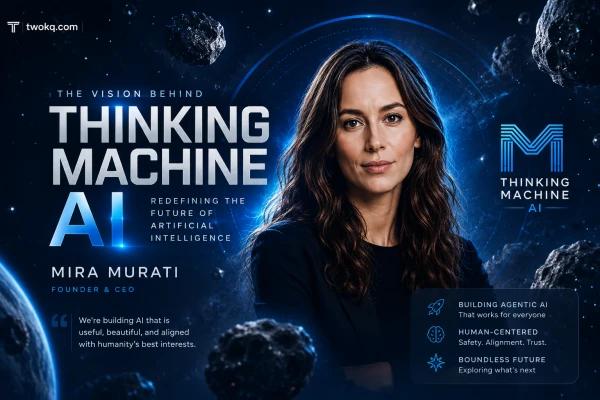
Former OpenAI Chief Technology Officer Mira Murati has officially unveiled Inkling, the first artificial intelligence model developed by her startup, Thinking Machines Lab. The launch marks one of the most closely watched AI debuts of 2026 and signals the arrival of another serious competitor in the race to build the next generation of advanced AI systems.
Murati founded Thinking Machines after leaving OpenAI, where she played a central role in the development and release of groundbreaking products including ChatGPT and GPT-4. Since launching the company, Thinking Machines has attracted billions of dollars in funding and recruited top researchers from OpenAI, Meta, Anthropic, and other leading AI laboratories. Expectations have been high ever since the company emerged from stealth mode, and Inkling is its first major public release.
Unlike many flagship AI models from OpenAI, Anthropic, and Google, Inkling is an open-weight model. This means developers can download, fine-tune, and customize the model for their own applications without relying entirely on a cloud-hosted service. While the model's training data and source code remain proprietary, its released weights make it far more flexible than fully closed AI systems.
Thinking Machines says Inkling was designed to balance performance, efficiency, and affordability. Rather than focusing only on achieving the highest benchmark scores, the company wants developers and businesses to adapt the model for specialized tasks such as software development, enterprise automation, document analysis, customer support, research, and multimodal AI applications.
The launch immediately places Thinking Machines alongside some of the world's biggest AI companies. OpenAI continues expanding GPT-5.6, Anthropic is strengthening its Claude family of models, Google is investing heavily in Gemini, while Meta and DeepSeek continue advancing their own open AI ecosystems. Inkling enters this competitive landscape by offering organizations another option that emphasizes customization instead of relying exclusively on proprietary cloud services.
Industry analysts believe Inkling's open-weight approach could appeal to businesses concerned about privacy, infrastructure costs, and vendor lock-in. Companies that prefer hosting AI models on their own servers or customizing models for industry-specific workflows may find Thinking Machines' strategy particularly attractive. This growing demand for adaptable AI models is reshaping enterprise AI adoption across finance, healthcare, manufacturing, education, and software development.
Thinking Machines has also introduced Tinker, a cloud platform that allows developers to fine-tune Inkling using their own datasets. Together, Inkling and Tinker form the foundation of Murati's long-term vision of creating AI systems that are easier to personalize while remaining powerful enough for professional and enterprise use.
The launch is significant not only because of the technology itself but also because of who is leading it. As one of the most influential former OpenAI executives, Mira Murati's return with a new AI model is likely to intensify competition across the industry. Investors and developers will closely watch whether Thinking Machines can translate its strong financial backing and world-class research team into widespread adoption.
Although Inkling is entering a market already dominated by OpenAI, Anthropic, and Google, it represents a different vision for artificial intelligence. By focusing on open-weight technology, enterprise customization, and developer flexibility, Thinking Machines is betting that the future of AI will not be controlled by a handful of closed platforms.
Instead, the company aims to give businesses and developers more control over how they build and deploy intelligent systems.
With Inkling now available, the next phase of AI competition has officially begun. The question is no longer whether Thinking Machines can build an advanced AI model—it has.
The next challenge will be convincing developers, enterprises, and researchers that Inkling deserves a place alongside GPT-5.6, Claude, and Gemini as one of the industry's leading AI platforms.