
29 Countries Unite to Launch World AI Cooperation Organization in Historic Move That Could Change Artificial Intelligence Forever
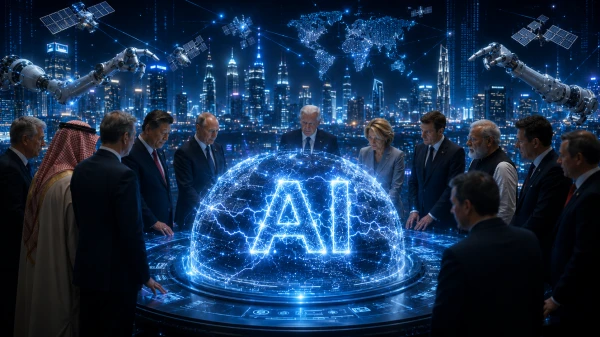
29 Countries Join Forces to Create a New Global AI Organization
Artificial intelligence has officially entered a new chapter in global history after twenty-nine countries signed an agreement to establish the World AI Cooperation Organization, an international body designed to strengthen cooperation on artificial intelligence development, governance, innovation, and regulation.
The agreement represents one of the most ambitious international AI initiatives ever announced and highlights how governments are beginning to treat artificial intelligence not simply as another emerging technology, but as infrastructure capable of reshaping economies, education, healthcare, national security, manufacturing, scientific research, and everyday life.
Unlike previous AI discussions that mostly focused on national strategies, this agreement seeks to create a framework where countries can work together rather than compete entirely independently as AI becomes increasingly powerful.
Why This Agreement Matters More Than Previous AI Announcements
The creation of a dedicated international AI cooperation body signals a dramatic shift in how governments view artificial intelligence. Until recently, many countries focused primarily on building domestic AI capabilities, investing billions of dollars into semiconductor manufacturing, data centers, large language models, and research laboratories.
However, the rapid acceleration of AI technologies has introduced challenges that no single nation can solve alone. Questions surrounding AI safety, ethical development, cybersecurity, misinformation, intellectual property, autonomous systems, and cross-border standards have become increasingly urgent.
The new organization aims to create a platform where participating nations can discuss these issues collectively while encouraging responsible innovation that benefits both developed and developing economies.
China Pushes for a Larger Role in Global AI Governance
China has positioned itself as one of the driving forces behind the new organization, reflecting its growing ambition to shape international AI policy. The announcement comes just ahead of the World Artificial Intelligence Conference (WAIC) in Shanghai, where Chinese leaders are expected to outline an even broader vision for international AI cooperation.
The timing is significant because China has invested heavily in domestic AI research, advanced semiconductor development, cloud computing infrastructure, robotics, and open-source AI models. Through this initiative, Beijing is attempting to present artificial intelligence as an area where international collaboration can coexist alongside technological competition.
The Global AI Race Is Entering a New Phase
For several years, discussions about artificial intelligence have largely centered on the competition between the United States and China. Companies such as OpenAI, Google DeepMind, Anthropic, Meta, Microsoft, Alibaba, Tencent, and numerous startups have accelerated the pace of innovation by releasing increasingly capable AI systems.
Governments have responded by investing billions into AI infrastructure while also introducing regulations intended to balance innovation with public safety. The establishment of an international AI cooperation organization demonstrates that governments increasingly recognize artificial intelligence as a geopolitical issue comparable to climate policy, international trade, or nuclear technology. Cooperation may become just as important as competition during the next decade.
What Could This Mean for Businesses and AI Companies?
Technology companies around the world will likely pay close attention to the organization's future decisions. If participating countries eventually agree on common AI standards, software developers, cloud providers, startups, and multinational corporations could benefit from more consistent regulatory expectations across different markets.
Standardized approaches to AI safety testing, transparency requirements, cybersecurity practices, and data governance may reduce uncertainty for companies expanding internationally. On the other hand, businesses may also face additional compliance obligations if new international AI guidelines become more comprehensive over time.
How Everyday People Could Be Affected
Although discussions about AI governance often appear technical, the decisions made by governments can have direct effects on millions of people. International cooperation could influence how AI systems protect personal data, detect misinformation, assist healthcare professionals, improve education, automate workplaces, and support scientific discoveries.
Consumers may eventually experience AI tools that operate under more transparent safety standards, while businesses could gain access to technologies developed through broader international collaboration.
The agreement also reflects growing recognition that artificial intelligence will increasingly influence employment, communication, transportation, entertainment, and financial services across virtually every sector of society.
Challenges Still Remain
Despite the optimistic announcement, creating a successful international AI organization will not be simple. Participating countries often have different legal systems, economic priorities, national security concerns, privacy regulations, and technological capabilities.
Reaching consensus on issues such as AI transparency, military applications, copyright protection, data sharing, and ethical guidelines may require years of negotiation. Experts also note that major AI powers continue to compete aggressively for technological leadership, meaning collaboration and competition are likely to exist simultaneously rather than replacing one another.
What Happens Next?
The signing of the agreement marks only the beginning of what could become one of the most influential international technology organizations of the coming decade. The coming months are expected to include additional meetings, working groups, policy discussions, and collaborative research initiatives that will define the organization's long-term objectives.
Meanwhile, the World Artificial Intelligence Conference in Shanghai is expected to introduce new AI technologies, advanced computing infrastructure, and additional international partnerships that could further shape the global AI landscape.
Governments, technology companies, investors, researchers, and consumers will all be watching closely as this new chapter in artificial intelligence governance unfolds.