
AI Is Starting to Study How Other AI Models Actually Think
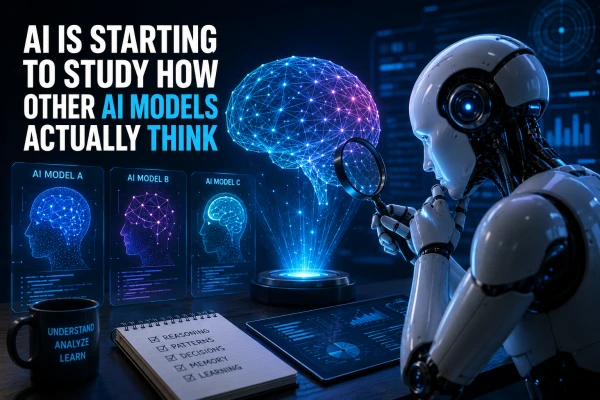
Artificial intelligence research is entering an unusual new phase where AI is no longer being used only as the subject of experiments. Researchers are increasingly using AI itself as a tool for investigating how other AI systems work, and a new research project called Mechanist shows how far this idea could go.
The system is designed to autonomously investigate the mechanisms behind AI behavior, generate hypotheses, run experiments and use the results to develop explanations about how models represent information and make decisions.
For years, understanding what happens inside a large AI model has been one of the biggest challenges in artificial intelligence. Researchers can observe what a model receives as input and what it produces as output, but the enormous number of parameters inside modern systems makes it difficult to understand exactly how individual capabilities emerge.
An AI can sometimes produce a correct answer without giving researchers a clear explanation of the internal processes that produced it, creating a growing gap between what AI models can accomplish and what humans actually understand about them.
Mechanist takes a different approach by treating AI itself as a research instrument. According to the researchers, the system combines an interpretability-focused knowledge graph containing roughly 13,000 papers with a much larger database containing 43 million research papers across 26 scientific fields.
It also includes a collection of methods for analyzing mechanisms, performing causal interventions and validating discoveries, allowing the system to move beyond simply reading research and toward conducting investigations.
That distinction could become extremely important as AI models become more complicated. A human researcher might spend weeks studying previous papers, designing an experiment, analyzing a model and deciding what to investigate next.
An AI research system could potentially automate parts of that process, allowing experiments to be proposed, tested and refined much faster. The goal is not simply to make AI produce research papers faster, but to use AI to investigate questions that are becoming increasingly difficult for humans to study manually.
One of the most interesting claims from the research is that Mechanist was able to move from identifying unusual model behaviors toward developing explanations for why those behaviors occur. The researchers say the system investigated how models represent world knowledge, form beliefs and reason about what other people believe. It also explored safety risks and used its findings to develop interventions intended to improve model behavior.
If systems like this continue improving, AI research could become significantly more automated. Instead of researchers manually testing every hypothesis, scientists could increasingly give an AI system a broad question and allow it to search existing knowledge, identify gaps, propose experiments, run evaluations and return the most promising findings. Humans would still need to verify the results, but the amount of scientific work that could happen between two human decisions could increase dramatically.
This could have a major effect on AI safety in particular. One of the biggest problems with increasingly capable models is that researchers need to understand dangerous behaviors before those systems are deployed widely.
If AI can help researchers discover hidden mechanisms behind a model's behavior, it could become possible to identify certain problems much earlier than traditional testing allows. That could give developers more opportunities to modify or restrict a system before the problem becomes difficult to control.
The research is also interesting because it suggests that AI may eventually become part of the feedback loop that creates better AI. Today, humans design models, train them, evaluate their capabilities and study their failures. In the future, increasingly capable AI systems could assist with nearly every stage of that process. An AI could help identify weaknesses in another model, design an experiment to investigate the weakness and suggest an intervention to address it.
That does not mean AI has suddenly learned to fully understand itself. The current research is still experimental, and the researchers are presenting Mechanist as a system for accelerating mechanistic investigation rather than as a complete solution to AI interpretability.
There are also major questions about whether AI-generated explanations are actually correct, whether the experiments can be independently reproduced and whether an AI system can reliably discover mechanisms that humans have overlooked.
Still, the direction is important. The AI industry has spent enormous resources making models larger, faster and more capable, but understanding those systems has not advanced at exactly the same pace. The 2026 AI Index report similarly highlights a growing gap between rapidly advancing AI capabilities and the systems needed to evaluate, govern and understand them.
The next generation of AI research could therefore look very different from today's research laboratories. Scientists may increasingly work with AI systems that function as research assistants, experiment designers, programmers and analysis engines at the same time. Instead of spending most of their time performing repetitive experiments, researchers could spend more time deciding which questions are important and verifying the discoveries produced by automated research systems.
There is also a much bigger possibility hiding behind this development. If AI becomes good enough at studying AI, future models could potentially help researchers discover techniques that humans would struggle to find independently. An AI system does not necessarily approach a problem with the same assumptions as a human researcher, which means it could potentially identify relationships or mechanisms that are difficult for people to notice.
That could create a new cycle of AI development. Better AI could help researchers understand existing models, those discoveries could help engineers build better models, and the improved models could then become better research tools for studying the next generation. The speed of development would no longer depend entirely on how quickly human researchers can perform experiments themselves.
The biggest question may eventually become whether humans can keep up with the systems they create. If AI begins contributing heavily to the discovery of new AI architectures, training methods and safety techniques, researchers will need reliable ways to verify what the systems discover. The challenge will not simply be getting AI to produce more discoveries; it will be determining which discoveries are real, reproducible and safe to use.
For now, Mechanist is an early example of this direction rather than proof that AI research has become fully autonomous. But it points toward a future in which artificial intelligence does more than answer questions about science. AI could increasingly become one of the instruments scientists use to investigate the technology itself.
And that may become one of the most important changes in AI research over the next few years: the machines we build could increasingly help us understand the machines we build next.
