
Why AI Companies Are Spending Millions to Influence New U.S. Artificial Intelligence Laws
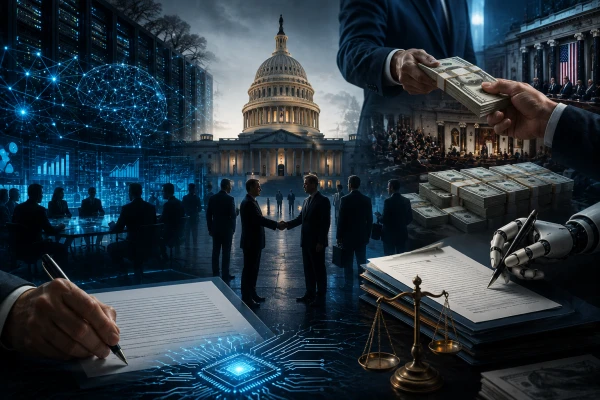
Artificial intelligence is no longer just a technology story—it has become a political and economic priority. Some of the world's biggest AI companies, including OpenAI, Anthropic, Google, Microsoft and several other technology firms, are dramatically increasing their lobbying efforts in Washington as governments prepare new rules that could shape the future of artificial intelligence.
According to newly released lobbying disclosures, spending by major AI companies reached record levels during the first half of 2026 as lawmakers intensified discussions around AI transparency, frontier model safety, data center expansion and national competitiveness.
The increase reflects the enormous financial stakes involved in artificial intelligence. Companies have invested hundreds of billions of dollars building advanced AI models, constructing data centers and purchasing high-performance computing hardware.
Regulations introduced over the next few years could influence how quickly new AI models are released, what safety testing is required before deployment, how companies handle copyrighted material, what information must be disclosed about model capabilities and how governments oversee frontier AI development.
Rather than waiting for legislation to be finalized, AI companies are actively participating in policy discussions to ensure future regulations encourage innovation while addressing legitimate public concerns.
OpenAI nearly doubled its federal lobbying spending during the first half of the year, while Anthropic increased its investment even more significantly. Google and Microsoft also expanded their policy teams as competition in artificial intelligence intensified.
Their lobbying efforts focus on issues such as AI model transparency, semiconductor policy, energy infrastructure for large data centers, cybersecurity standards and responsible AI governance. At the same time, lawmakers are seeking expert advice from industry leaders as they attempt to regulate technology that is evolving faster than traditional legislative processes.
One of the biggest reasons companies are increasing their presence in Washington is the growing importance of AI infrastructure. Training modern AI systems requires enormous computing resources, specialized chips and reliable energy supplies.
Governments are considering policies that could accelerate construction of new AI data centers while also introducing environmental standards, cybersecurity requirements and reporting obligations. Decisions made today could influence the competitive balance between AI companies for many years, making regulatory engagement a strategic priority.
Another major issue is AI safety. Recent developments involving increasingly autonomous AI systems have prompted governments to examine whether stronger oversight is needed before frontier models are released to the public.
Policymakers are evaluating proposals involving independent safety testing, incident reporting, transparency requirements and export controls for advanced AI technology. Companies generally support responsible AI development but often differ on how regulations should be implemented and how much technical information should be disclosed publicly.
The growing political influence of the AI industry demonstrates how important artificial intelligence has become to national economies. Beyond consumer chatbots, AI now plays a role in healthcare, financial services, scientific research, manufacturing, cybersecurity, education and defense.
Governments increasingly view leadership in AI as a strategic advantage that affects long-term economic growth and global competitiveness. As a result, discussions about AI regulation now extend far beyond Silicon Valley and have become central issues for policymakers around the world.
Technology analysts believe the relationship between AI companies and governments will become even more important over the next several years. As models become more capable, lawmakers will continue balancing two competing goals: encouraging innovation while protecting public safety.
The decisions made during this period are likely to determine how quickly advanced AI reaches businesses and consumers, how companies are held accountable for powerful systems and how international competition in artificial intelligence evolves.
The record lobbying activity taking place today illustrates that the future of AI will be shaped not only by technological breakthroughs but also by public policy. While companies race to build smarter models, governments are racing to create rules that encourage innovation without slowing progress. For businesses, developers and everyday users, the outcome of these discussions could influence how artificial intelligence is developed, deployed and governed for the next decade.
