
Why Silicon Valley Is Racing to Build America's Next Open AI Model
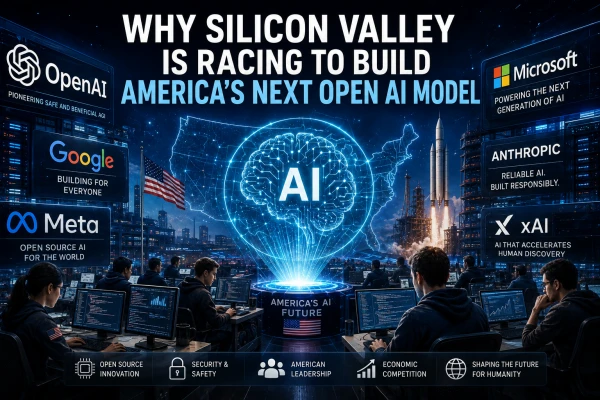
The global artificial intelligence race is entering a new chapter as Silicon Valley startups push to build the next generation of open AI models capable of competing with rapidly improving systems from China.
While companies such as OpenAI, Anthropic and Google continue to dominate the frontier AI market, a new wave of American startups believes the future will also belong to powerful open-weight models that developers and businesses can run on their own infrastructure.
The renewed competition follows the rapid rise of Chinese AI companies that have released increasingly capable language models at significantly lower costs. Those models have attracted developers because they can often be customized, deployed locally and operated without depending entirely on commercial cloud APIs.
Their growing popularity has increased pressure on American AI companies to offer alternatives that combine strong performance with greater transparency and flexibility.
One company drawing attention is Arcee AI, a relatively small startup that recently demonstrated it could build a competitive open-weight large language model using a fraction of the budget typically associated with frontier AI development.
Instead of spending billions of dollars on training, the company focused on efficiency and optimization, showing that smaller teams may still compete with industry giants through smarter engineering.
Nvidia has emerged as one of the biggest supporters of this movement. Beyond selling the graphics processors that power modern AI systems, the company is encouraging the growth of an ecosystem of American open-weight AI models.
Industry observers believe this strategy could reduce dependence on foreign technologies while giving developers more choices for deploying AI in businesses, research institutions and government projects.
The debate over open versus closed AI is becoming increasingly important. Closed commercial models generally provide centralized updates, managed infrastructure and enterprise support. Open-weight models, however, allow organizations to inspect, customize and deploy AI on their own servers, an advantage that appeals to industries with strict security or privacy requirements.
Governments are also paying close attention. Artificial intelligence is now viewed as critical infrastructure with implications for national security, scientific research and economic competitiveness.
As China and the United States continue investing heavily in AI development, policymakers are exploring how to strengthen domestic innovation while protecting sensitive technologies.
For businesses, this competition is good news. Greater competition usually leads to faster innovation, lower operating costs and a wider range of AI tools. Companies adopting artificial intelligence may soon have more options than ever before, whether they prefer commercial AI platforms or customizable open-weight models designed for specialized workloads.
The rise of startups building American open AI models also demonstrates that innovation is no longer limited to the largest technology companies. Smaller organizations are proving they can make meaningful contributions to the AI ecosystem through efficient engineering, focused research and strategic partnerships.
As the global AI race continues, the competition between open and proprietary models may become just as significant as the battle between countries. The next breakthrough in artificial intelligence may not come only from the biggest companies—it could also come from agile startups determined to redefine how advanced AI is built, shared and deployed.
