
Why OpenAI Shut Down Atlas: The Real Future of AI Browsing Is ChatGPT
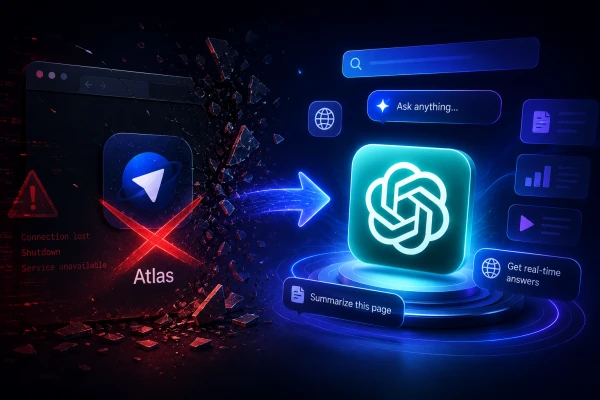
OpenAI has made a surprising strategic decision by shutting down Atlas, its experimental AI-powered browser, only months after introducing it. While many observers expected the company to continue building a direct competitor to Google Chrome, OpenAI has instead chosen a different direction.
Rather than asking users to install a completely new browser, the company is moving Atlas' most advanced AI browsing capabilities directly into ChatGPT and its Chrome extension. The decision reflects a broader shift in how OpenAI believes people will interact with artificial intelligence while browsing the web.
Instead of becoming another standalone browser fighting for market share, ChatGPT is evolving into an intelligent workspace that can understand webpages, summarize information, answer questions about what users are reading and even complete certain browser-based tasks without requiring people to leave their existing browsing experience.
According to OpenAI, features originally developed for Atlas will now power both the ChatGPT desktop application and a new Chrome extension, allowing users to access AI assistance wherever they already work online.
This strategy highlights an important reality of today's browser market. Google Chrome remains the world's most widely used browser, and convincing billions of users to abandon it would be an enormous challenge.
Instead of competing directly on browser market share, OpenAI is focusing on embedding artificial intelligence into existing workflows. By integrating ChatGPT into Chrome and its desktop application, the company can reach users without requiring them to change their browsing habits.
The move also reflects a broader trend across the AI industry. Companies are increasingly realizing that users want AI to work inside the tools they already use rather than forcing them to learn entirely new software. Google's Gemini now appears inside Chrome, Microsoft continues expanding AI throughout Edge, and Perplexity is investing heavily in its Comet browser.
OpenAI's decision suggests that intelligent browsing features may ultimately become standard capabilities available across multiple browsers instead of existing inside a single dedicated application.
One of the biggest advantages of this new approach is continuous context. Instead of copying and pasting text into ChatGPT, users can ask questions about the page currently open in their browser, request summaries, compare information across websites and even allow AI agents to complete certain online tasks.
OpenAI is also expanding browser functionality within the ChatGPT desktop application itself, enabling AI agents to interact with websites, log into accounts and perform more sophisticated workflows on behalf of users.
Developers and businesses may benefit significantly from these changes. Researchers can summarize long technical documents without leaving the browser. Marketing teams can quickly analyze competitor websites.
Software developers can ask ChatGPT to explain code directly from documentation pages, while students can receive simplified explanations of complex academic material. By embedding AI into everyday browsing rather than creating another destination, OpenAI is attempting to reduce friction while increasing productivity.
The decision to retire Atlas does not mean OpenAI has abandoned AI browsing. On the contrary, it suggests the company believes AI should become an invisible layer that enhances every browsing session instead of existing as a separate product. This philosophy differs from launching another browser but could ultimately reach far more users because it builds upon software people already use every day.
Artificial intelligence is changing how people search, read and interact with information online. OpenAI's decision to discontinue Atlas while expanding ChatGPT's browser capabilities demonstrates that the future of AI may not depend on replacing existing browsers, but on making them dramatically smarter. As AI assistants become increasingly integrated into everyday computing, the browser itself may become less important than the intelligence working behind it.