
Unitree Robotics Soars 460% in Shanghai Debut as China’s First Major Humanoid Robot IPO
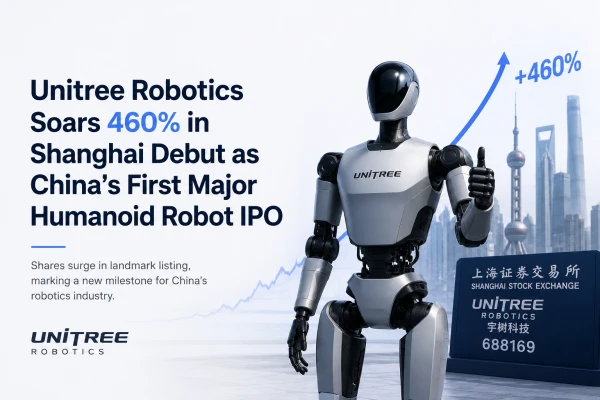
Unitree Robotics, one of the world’s largest makers of humanoid and quadruped robots, made a blockbuster debut on Shanghai’s STAR Market on August 19, 2026. Shares closed 460% above the IPO price after opening as much as 629% higher, valuing the company at roughly $50 billion and marking the first major mainland listing of a pure-play humanoid robot developer.
The Hangzhou-based company, officially known as Yushu Technology and trading under ticker 688836.SH, priced its offering at 150.80 yuan per share. It sold approximately 40.45 million new shares—about 10% of the post-issue capital—raising around 6.1 billion yuan, or roughly $900 million.
Retail demand was extreme: the retail tranche was oversubscribed more than 5,500 times, the highest level recorded for a STAR Market IPO since the board’s launch.
At the close of 845 yuan, Unitree’s market capitalization stood near 342 billion yuan.
The first-day gain far exceeded the average 279% opening pop for Chinese IPOs so far in 2026 and came even as the broader CSI 300 index fell about 3% amid a global technology sell-off.
From Quadrupeds to Humanoids
Unitree did not begin as a humanoid specialist. Founder Wang Xingxing, now 36, left a university laboratory in 2016 to build the company around quadruped robots.
The Go, A and B series established an early commercial base in research, education and industrial inspection. Quadruped revenue grew from 92.8 million yuan in 2022 to 698 million yuan in 2025. Cumulative sales of robot dogs have exceeded 33,000 units.
Humanoid robots then became the growth engine. In 2023 they contributed less than 2% of revenue. By 2025 humanoid sales reached 868 million yuan, more than half of the company’s 1.699 billion yuan total revenue.
Unitree reported net profit of 278 million yuan for the full year and a gross margin above 60% on core businesses. The company says it shipped more than 5,500 humanoid units in 2025, claiming the global lead in volume. Average selling price for its humanoids was approximately 166,400 yuan.
First-half 2026 revenue continued to rise, reaching 1.15 billion yuan, up nearly 49% year-on-year, although adjusted profit declined as research and marketing spending increased. Overseas sales accounted for about 44% of main-business revenue in 2025.
Strategic Backing and National Priorities
Unitree has attracted high-profile investors. Strategic participants in the IPO included DeepSeek, a Tencent-linked vehicle and investment arms of major state-owned enterprises. Earlier backers include Alibaba, Ant Group and Tencent. Wang Xingxing held a front-row seat at a 2025 summit with Chinese President Xi Jinping and technology executives, underscoring the company’s alignment with national industrial priorities.
The listing coincided with the opening of the 2026 World Robot Conference in Beijing. Chinese policymakers view humanoid and embodied AI systems as a strategic response to demographic pressures and as a new growth pillar after the electric-vehicle and battery waves.
A wave of additional robotics listings is expected; firms including Deep Robotics, Leju Robotics, Mech-Mind, X Square Robot and AgiBot are preparing mainland or Hong Kong offerings.
Commercial Reality Versus Hype
Despite the valuation, most of Unitree’s robots have so far been sold to research institutions and universities rather than deployed in high-volume commercial settings. Industry observers note that the company remains an outlier in achieving profitability while many peers continue to post losses. Its strengths lie in mechanical design, actuators, motion control and rapid product iteration.
The next competitive phase, analysts say, will center on embodied intelligence—foundation models that allow robots to perceive, reason and act in unstructured environments.
Unitree has indicated that a substantial portion of the IPO proceeds will fund intelligent robot model research, body development, new product creation and a manufacturing base. Management has signaled plans to expand investment in AI capabilities that complement its hardware platform.
Geopolitical Headwinds
External constraints are already visible. In July 2026 the U.S. Federal Communications Commission banned imports of future models of foreign-made humanoid and quadruped robots, a measure widely viewed as targeting Chinese suppliers including Unitree.
The U.S. Defense Department also added the company to a list of entities linked to China’s military-industrial base, limiting future U.S. government use of its technology. Unitree states that its products are intended for civilian applications.
These restrictions close off a large potential market and highlight the broader technology rivalry. Unitree’s designs for successful quadruped platforms drew in part on openly published U.S. military research, a common practice that the company has not been accused of misusing. The episode nevertheless illustrates how Chinese firms have scaled technologies originally advanced in the United States.
Why the Debut Matters
Unitree’s listing provides the first large-scale public-market valuation anchor for a profitable Chinese humanoid robotics company. At closing prices the firm trades at hundreds of times 2025 earnings and more than 200 times sales—levels that reflect scarcity of pure-play listed peers and intense domestic investor enthusiasm rather than near-term cash-flow metrics.
For the global robotics sector the debut signals that capital markets in China are prepared to fund the transition from laboratory demonstrations and viral videos to scaled production and real-world deployment.
Whether Unitree can convert its hardware lead into durable AI-driven differentiation will determine if the current valuation proves justified or speculative. In the meantime, the IPO has already elevated Wang Xingxing’s paper wealth into the multi-billion-dollar range and set a high bar for the next wave of Chinese robotics companies seeking public capital.
The story of Unitree is no longer only about robots that dance or perform martial arts. It is about whether embodied AI can move from impressive demos into reliable, economically viable machines at industrial scale—and whether China can lead that transition under growing external constraints.