
Seattle AI BioDesign Opens With $95 Million to Engineer New Proteins
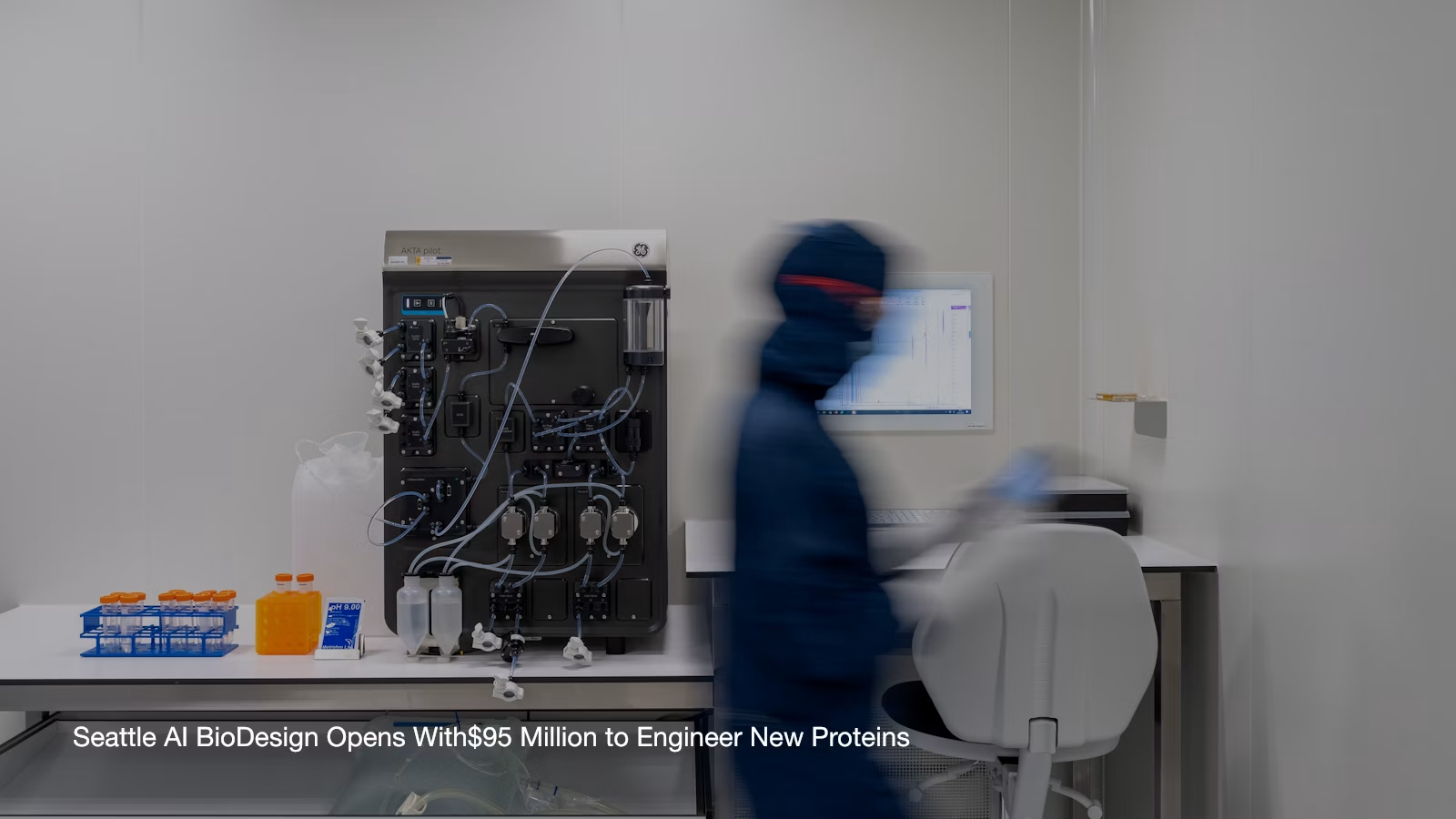
Seattle AI BioDesign has opened with $95 million to engineer proteins, genes and other biological tools that do not exist in nature. The Seattle research accelerator will pair generative models with large-scale laboratory experiments rather than treating computer predictions as finished discoveries.
Announced on September 3, the program brings together the Allen Institute, the University of Washington and Fred Hutch Cancer Center. Funding comes from the Fund for Science and Technology, a private foundation in the Paul G. Allen philanthropic ecosystem, and the initiative is planned to run for at least five years.
Seattle AI BioDesign Research Plan
The project is built around a scientific gap that remains after rapid advances in protein prediction and generation. Models can produce vast numbers of plausible sequences, but researchers still need physical experiments to learn which designs fold correctly, interact with intended targets and function safely inside cells.
AI BioDesign will focus on multiple modular models tied to biological problems that can be tested at scale. Rather than pursue one flagship drug, the partners plan to build a reusable research platform spanning model development, assays, reagents, datasets and benchmarks.
The initial research targets include:
- Custom proteins engineered to bind disease-related targets
- Genetic switches designed to turn genes on or off
- Tools that selectively degrade or stabilize proteins
- Engineered cells intended to recognize and remove cancer
- Enzymes that could break down environmental plastics
Those goals range from near-term biomedical research to longer-range environmental and computing concepts. The launch announcement also identifies neurodegeneration treatments and lower-power biological computers as potential applications, but it does not claim that any of those products already exist.
"For the first time, the speed of AI is beginning to match the experimental power of synthetic biology."
David Baker, the 2024 Nobel laureate in chemistry and director of the UW Medicine Institute for Protein Design, made that assessment in the launch announcement. He is serving as a lead scientific director alongside genome scientist Jay Shendure.
How the Laboratory Loop Works
The central mechanism is a design-build-measure-learn cycle. AI systems will propose biological sequences or perturbations, laboratory teams will construct and test them, and the resulting measurements will return to the models as new training and evaluation data.
That feedback matters because biological design is not a text-only prediction problem. A sequence that looks convincing to a model can still fail to fold, bind weakly, trigger an unwanted response or behave differently in a cell than it did in a simplified assay.
AI BioDesign plans to use multiplex experiments so many candidates can be tested in parallel. Each round can then improve both the model and the experiment-selection strategy, gradually replacing broad trial and error with more informed searches across an immense biological design space.
Further Reading
Open Science Across Three Institutes
The institutional mix gives the project capabilities that are difficult to assemble inside a single laboratory. The Allen Institute contributes experience running large-scale open-science programs, while UW teams bring protein design, synthetic biology, genome science and precision-medicine expertise.
Fred Hutch adds cellular systems, genomics and translational medicine. That combination is intended to connect molecular generation with experiments in realistic biological settings, an important step if computer-designed tools are eventually to influence drugs, diagnostics or engineered cells.
The partners say models, datasets, assays, reagents and benchmarks will be shared openly. If they deliver on that commitment, outside laboratories could examine failure cases, reproduce results and adapt the platform without rebuilding every component behind institutional walls.
Open release could also make the project commercially consequential without turning the accelerator into a conventional startup. Biotechnology companies may be able to use validated building blocks, while model developers gain experimental datasets that are scarce, expensive and more informative than sequences scraped from public archives.
Translational Hurdles Remain
The $95 million commitment buys time, automation and scientific coordination; it does not remove the long validation path between a promising molecule and an approved therapy. Toxicity, manufacturing, delivery, durability and regulatory evidence remain separate problems after a model generates a candidate.
The project has not yet published a benchmark, a validated new molecule or a clinical timetable. Its progress should therefore be judged through reproducible releases and experimentally confirmed functions, not by the volume of designs that its models can produce.
Near-term signals will include the first public datasets, the choice of assays and whether other laboratories can repeat the reported results. Over five years, the harder test will be whether the closed laboratory loop learns design rules that transfer beyond one protein family or experimental system.
AI BioDesign is significant because it treats laboratory evidence as the engine of model improvement, not a final demonstration attached to a software release. If that architecture works, Seattle's institutions could give AI biology a shared experimental foundation—and expose its limitations just as openly.