
Salesforce Launches Enterprise AI Harness With AI Control Plane
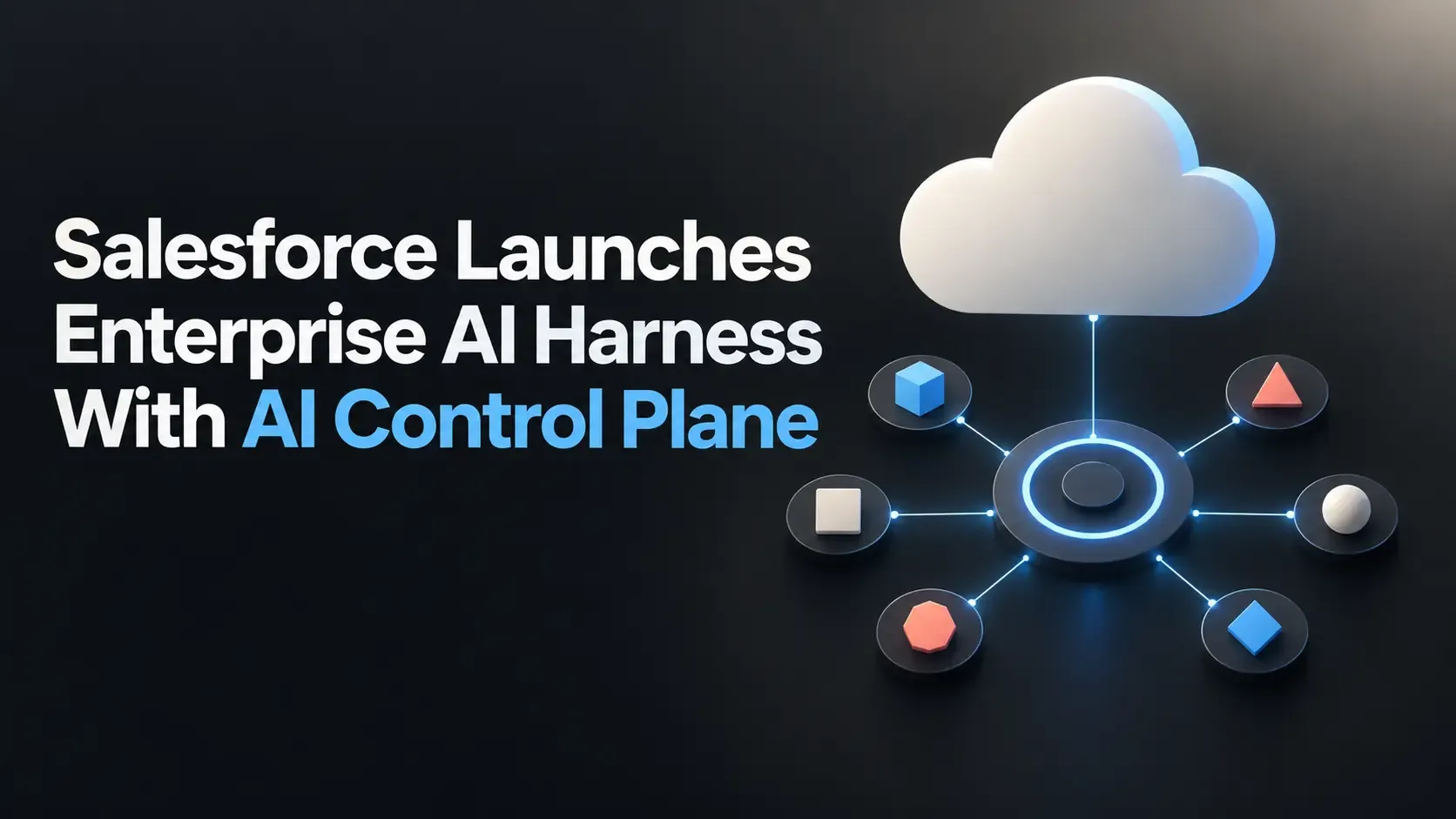
Salesforce launches Enterprise AI Harness as a common architecture for giving enterprise agents context, tools, policies and model access. The package also introduces an AI Control Plane intended to inventory and govern agents operating across Salesforce and third-party systems.
The announcement shifts Salesforce’s agent strategy from individual assistants toward a reusable operating layer. Some underlying technologies are already available, but the unified experience and additional capabilities are scheduled to begin rolling out in early fiscal 2028, with pricing and packaging still undisclosed.
The Enterprise AI Harness groups six connected capabilities:
- Trusted Context for governed business data and memory
- Trusted Agency for planning and orchestration
- Trusted Action for APIs, workflows and tools
- Trusted Governance for policy, lineage and quality
- Trusted Security for identity, permissions and privacy
- Trusted Models for routing work across AI providers
Salesforce Launches Enterprise AI Harness Around Six Layers
Salesforce’s September 11 announcement describes the harness as a composable architecture built from Data 360, Informatica, MuleSoft, Agent Fabric, Tableau, Agentforce, Salesforce Guardian and the core Salesforce Platform. Customers can use all six layers together or adopt selected components.
Trusted Context is designed to combine customer records with metadata, business definitions, real-time signals, knowledge and memory. Salesforce argues that agents need this shared understanding before they can answer operational questions that span CRM, inventory, contracts, analytics and prior interactions.
Trusted Agency supplies reasoning, planning, state and coordination, while Trusted Action connects those plans to applications, APIs and workflows. The design deliberately combines probabilistic model reasoning with deterministic controls where a company needs repeatable execution, approval rules or a verifiable handoff to a person.
The remaining layers address governance, security and model choice. They are meant to apply lineage, quality controls, permissions and runtime safeguards consistently, while routing tasks by accuracy, performance, cost and business requirements instead of locking every workflow to one model.
The AI Control Plane Targets Agent Sprawl
The new AI Control Plane is the management layer for discovering and registering agents and AI capabilities. Salesforce says administrators will be able to assign identity and policy, oversee lifecycles, evaluate performance, observe behavior and outcomes, and track cost from one place.
That scope extends beyond Salesforce software. The harness is being built headlessly, with access through MCP, APIs, skills and plug-ins, and Salesforce names Claude, Slack, Microsoft Teams and Agentforce among the experiences it expects the architecture to support.
VentureBeat’s independent coverage frames the problem as one of fragmentation: large organizations are already accumulating agents from multiple vendors. A cross-platform register can matter because an untracked agent may retain permissions, consume budget or take actions outside a team’s normal software inventory.
Background Reading
Agentforce Adds Long-Horizon Work and Job-Ready Agents
The harness announcement arrives alongside a broader Agentforce product expansion. Salesforce introduced job-ready agents for service, IT and HR, commerce, sales, supply chains and customer operations, positioning them as configurable starting points rather than assistants that every customer must assemble from scratch.
Three of the named agents—Casey for support, Paige for employee service and Carter for shopping—are generally available now. Marshall, Piper and Fin are also listed as generally available, while the Hunter outbound-sales agent is in pilot with general availability planned for November 2026.
Hunter is the first to use Agentforce’s new long-horizon runtime. Memory preserves progress across sessions, durable execution lets a plan resume or change course, and dynamic steering adjusts behavior from user direction. The aim is to support work that lasts days or weeks, such as researching accounts and advancing a sales pipeline.
Salesforce also says Multi-Agent Orchestration is generally available. AI Skills, which lets workers teach an Agentforce Coworker a task, is in pilot with an October 2026 target, while Agent Optimizer is expected to reach general availability that month.
Availability Leaves Key Commercial Questions Open
The launch is partly an architecture announcement and partly a product roadmap. Salesforce says many foundation technologies are available today, yet the unified harness experience and new capabilities will only begin rolling out in early fiscal 2028. It has not published detailed pricing, packaging or regional availability.
Existing customers are promised upgrade paths for eligible investments, but Salesforce cautions buyers to base decisions on currently available products. That distinction is important because a control plane has value only when it can discover the relevant agents, enforce policy across them and present reliable operational evidence.
The larger competitive claim is that enterprise context and control will matter more than allegiance to a single model. If Salesforce can make its CRM records, workflows, permissions and acquired integration products function as one governed agent layer, it may reduce the custom infrastructure companies need to maintain around every AI deployment.
Execution will determine whether that promise holds. Customers will need to test how deeply third-party agents integrate, whether policies remain consistent across surfaces, how costs are attributed and which capabilities require paid upgrades when the unified experience starts arriving.