
Nvidia Backs OpenAI’s Massive Ohio AI Campus With Up to $105 Billion Guarantee
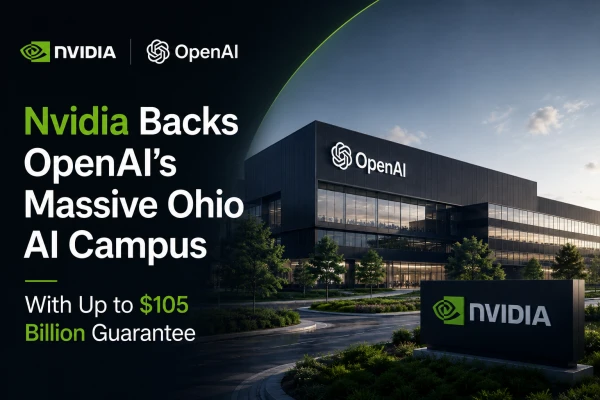
Nvidia has agreed to provide residual-value guarantees totaling as much as $105 billion to support the first phase of a sprawling artificial-intelligence data-center campus in southern Ohio that will be leased exclusively to OpenAI.
The arrangement, disclosed on August 17, 2026, marks one of the largest infrastructure financing commitments yet by the chipmaker and underscores how Nvidia is moving beyond simply selling GPUs to underwriting the physical foundations of the AI boom.
The project, known as the PORTS-Pike Technology Campus, is being developed by SoftBank subsidiary SB Energy on a mix of private land and remediated federal property at the former Portsmouth Gaseous Diffusion Plant in Pike County.
OpenAI has signed a 20-year lease securing approximately 8 gigawatts of IT capacity. Nvidia will serve as the exclusive provider of AI compute infrastructure for the site and is backing the initial 4.25 gigawatts of land, power and shell capacity, with an option to extend support to the remaining 3.75 gigawatts.
According to Nvidia’s SEC filing and official statements, the company’s cumulative payment obligation under the residual-value guarantees is capped at $105 billion. The guarantees become effective as individual leases commence and are structured so that Nvidia covers any shortfall only after SB Energy first attempts to find a replacement tenant or sell the facilities.
Nvidia has emphasized that the arrangement is not a direct guarantee of OpenAI’s rent payments; OpenAI will begin paying only as completed capacity becomes available, expected to start with 800 megawatts in 2028.
In addition to the guarantees, Nvidia is investing $1.5 billion in SB Energy, joining SoftBank and OpenAI as shareholders. SB Energy and SoftBank plan to construct at least 10 gigawatts of new energy generation—primarily natural gas—to support the 8 gigawatts of IT load, and will invest $4.2 billion in regional grid upgrades through a partnership with AEP Ohio. Those grid costs will not be passed on to Ohio ratepayers.
OpenAI and SB Energy project that the six-year buildout through 2032 will create 35,000 construction jobs and 2,500 permanent operating positions. The companies have also committed more than $80 million to a community benefits fund—$40 million each—for local priorities such as schools, workforce training, housing and public services. OpenAI is separately providing up to $84 million in Codex credits to roughly 844,000 eligible Ohio college and technical-school students.
Why the Structure Matters
The residual-value approach reflects Nvidia’s evolving role in the AI ecosystem. Rather than simply selling chips, the company is helping de-risk the long-lived physical infrastructure required to deploy successive generations of its hardware.
Jensen Huang, Nvidia’s founder and chief executive, described the deal as securing “long-lived infrastructure for Nvidia compute so OpenAI can deploy the most productive AI factories that can be upgraded repeatedly with each new generation.”
Each generation of Nvidia systems at the site could involve roughly 1.5 million GPUs, potentially representing $150 billion to $200 billion in revenue for the chipmaker. Across all of OpenAI’s commitments through 2030, Huang has estimated demand for about 12 gigawatts of Nvidia compute; exercising the full option at PORTS-Pike could raise that figure higher still.
OpenAI has framed the project as essential to meeting projected demand for frontier training and product inference while maintaining its research lead. Sam Altman, OpenAI’s chief executive, noted that the campus would supply “enough computing power to help millions of people use AI to do things we can only start to imagine today.”
The company stressed that it will fund lease payments from its own revenue growth and capital raises, and that development remains contingent on permits, environmental reviews and financing.
Broader Context and Implications
The Ohio campus sits on a Cold War-era nuclear site that once enriched uranium for national security and commercial reactors. Its redevelopment into AI infrastructure aligns with federal efforts to repurpose such facilities for advanced manufacturing and computing. The Trump administration has supported the conversion, and the project involves coordination with the Department of Energy and Department of Commerce.
The deal also highlights the intensifying capital intensity of frontier AI. Data centers of this scale require not only chips but secure power, cooling, transmission and long-term offtake agreements. By underwriting residual value, Nvidia reduces financing costs for the developer while locking in exclusive use of its full-stack DSX AI factory platform—GPUs, CPUs and networking—across the initial phase.
Critics have raised questions about circular financing in the AI supply chain, in which chipmakers, model providers and infrastructure developers increasingly invest in one another. Nvidia and OpenAI have both rejected that characterization for this transaction. Huang stated publicly that “OpenAI will pay the lease,” and OpenAI confirmed it pays only for delivered capacity.
For southern Ohio the economic stakes are substantial. Beyond construction and operating jobs, the project is expected to generate hundreds of millions of dollars in state and local tax revenue over its lifetime, primarily supporting public schools and infrastructure.
Local hiring preferences, apprenticeship programs and an Ohio Community Compact are intended to ensure benefits flow to residents of Pike County and surrounding areas.
The first capacity is scheduled to come online in 2028. Full buildout will stretch into the early 2030s, coinciding with successive generations of Nvidia hardware and continued growth in demand for large-scale model training and inference.
Whether the residual-value guarantees are ever drawn upon will depend on OpenAI’s financial performance and the broader health of the AI market. For now, the arrangement provides a concrete illustration of how the industry’s largest players are coordinating to secure the physical capacity required for the next phase of AI development.