
UK AI Chip Startup Fractile Seeks $6.5 Billion Valuation After $250 Million Anthropic Deal
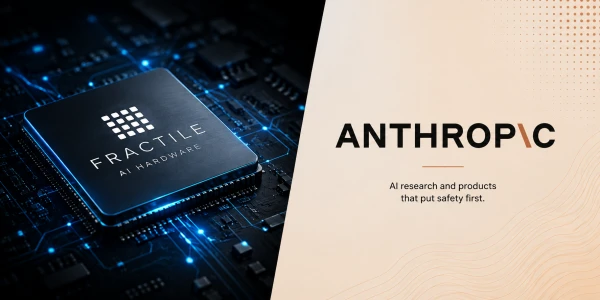
British AI chip startup Fractile is in advanced talks to raise approximately $600 million at a pre-money valuation of $6.5 billion, according to people familiar with the matter cited by Bloomberg. The figure marks more than a sixfold increase from the roughly $1 billion valuation the company secured just three months earlier.
The surge follows an initial agreement under which Fractile will supply Anthropic with about $250 million worth of its specialized inference chips. The two sides intend to expand the contract in the future, though the chips themselves are not expected to be ready for deployment until 2027.
Fractile and Anthropic both declined to comment on the reports. The funding round has not closed and terms could still change. Lightspeed Venture Partners and Redpoint Ventures are reported to be co-leading, with Thrive Capital and Founders Fund also expected to participate.
Founded in 2022 by University of Oxford roboticist Walter Goodwin, Fractile designs chips that place compute and memory on the same die using SRAM rather than relying on separate DRAM. The architecture targets the inference stage of AI workloads—the process of running already-trained models to generate answers, reason through multi-step tasks, or power agents.
Inference has become a growing share of the compute bill for frontier labs as models move from single responses to long chains of reasoning and persistent agent activity. Fractile has pitched its approach as delivering substantially higher throughput and lower cost than general-purpose GPUs for these workloads.
Earlier investor materials referenced claims of up to 25 times faster performance at one-tenth the cost under certain conditions, though production silicon has not yet been validated at scale.
In May 2026 the company closed a $220 million round led by Accel, Founders Fund and Factorial Funds, with former Intel chief executive Pat Gelsinger participating as an angel investor. That capital was earmarked to take the first chips through tape-out, software-stack development and early customer integration. The new raise, if completed, would give Fractile significantly more runway to reach volume production and expand its customer base.
Anthropic’s willingness to commit capital to unshipped silicon illustrates the intensity of the current scramble for inference capacity. The Claude developer already draws on Nvidia GPUs, Google TPUs and Amazon silicon, and has been exploring additional suppliers as demand scales. Locking in early access to a specialized architecture is a hedge against both cost pressure and potential supply constraints on mainstream accelerators.
Fractile is one of several startups attempting to carve out a position against Nvidia’s dominant position in AI compute. Competitors include wafer-scale specialist Cerebras Systems and other venture-backed inference chipmakers. The market has seen a wave of large raises this year as investors bet that purpose-built silicon can undercut general-purpose GPUs on the metrics that matter most for production inference.
The company’s British base is notable in a sector still dominated by U.S. firms. It joins a small but growing cluster of UK hardware startups attracting American venture capital. Fractile operates primarily from London and Bristol and has previously expanded engineering capacity in those locations.
For the broader AI industry the deal highlights how quickly a single major customer commitment can reprice a pre-revenue hardware company. Three months ago Fractile was a roughly $1 billion startup still years from shipping product.
Today it is negotiating at a valuation that places it among the more richly valued names in the AI chip race—entirely on the strength of an Anthropic supply agreement and the market’s appetite for Nvidia alternatives.
Whether that valuation holds will depend on execution. Delivering production silicon in 2027 that meets the performance and cost targets will be the decisive test. Until then the Fractile story stands as a clear signal of how acute the inference bottleneck has become for frontier labs and how far investors are prepared to stretch to back potential solutions.
As AI systems grow more agentic and long-running, the economics of generating each successive token will only become more central. Specialized inference hardware is one of the few levers labs and cloud providers can still pull to keep those costs in check. Fractile’s rapid revaluation shows just how valuable that lever has become.