
Binance Launches Agent OS, Letting ChatGPT, Claude and Cursor Trade Crypto on Users' Behalf
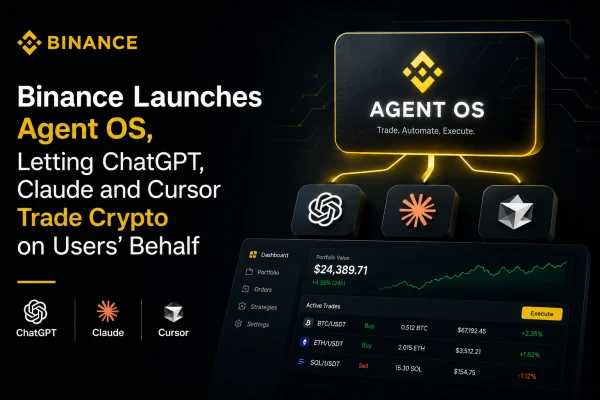
Binance, the world's largest cryptocurrency exchange with more than 300 million registered users, has launched Agent OS, a developer platform that allows artificial intelligence agents to analyze markets, manage portfolios and execute trades on behalf of users.
The platform, announced on August 20, 2026, connects compatible AI applications including OpenAI's ChatGPT and Codex, Anthropic's Claude Code, and Cursor to Binance's trading, market data, wallet, payment and on-chain infrastructure. Users authorize the agents and set permissions, giving software the ability to act with real funds inside controlled boundaries.
Agent OS forms part of Binance Intelligence, the exchange's broader initiative for AI-powered products. It unifies existing tools such as Binance APIs, the Wallet Agentic Hub, the x402 payment facilitator and Skill Hub, while adding support for the Model Context Protocol, or MCP. MCP is an open standard that lets AI applications discover and call external tools through a single connection.
According to Binance, developers can now build agentic experiences without stitching together one-off integrations. Compatible agents can pull live market data, check balances, place spot and futures orders, move funds between wallets and interact with decentralized finance protocols, all subject to user-configured limits.
The core safety mechanism is the Agentic sub-account. Users open a dedicated sub-account, transfer only the funds they are prepared to risk, and assign the agent to that account. Withdrawals from the sub-account are blocked by default.
The amount of capital transferred effectively becomes the agent's maximum exposure. Users can also choose whether every order requires approval or whether the agent may trade autonomously once permissions are set.
Jeff Li, Binance's vice president of product, told TechCrunch that the design places control at the account level. "Instead of total freedom, we put the power in users' hands to give them the granular access control of what they can do through the agent," Li said. "We put the control at the account level to protect the users' funds."
Binance does not impose a separate exchange-wide cap on how much an agent can trade or lose inside its sub-account. For on-chain and payment activity the company has set daily limits: regular swaps are capped at $50,000, DeFi transactions default to $100,000, and x402 payments are limited to $20 per day.
The reasoning that leads an agent to place a particular trade occurs outside Binance's systems, either on the user's device or inside the chosen AI application. Binance can monitor the resulting orders but has limited visibility into the agent's internal decision process. Existing security, risk-control and anti-money-laundering policies that already apply to sub-account APIs also cover Agent OS.
Trading is the first major use case. Agents can monitor markets, conduct research and risk analysis, react to signals and execute strategies such as arbitrage. The same infrastructure supports payments and on-chain activity through the Agentic Wallet and x402 integration.
Setup is designed to be straightforward for compatible tools.
Users add Binance's MCP endpoint, open and fund an Agentic sub-account, and authorize the agent. The agent cannot move funds from a main account into the sub-account; only the user can do that. Compatible applications listed by Binance include Claude Code, Claude, Codex, ChatGPT and VS Code.
Binance is not the first exchange to open its rails to AI agents. Kraken launched an open-source command-line tool with an MCP server earlier in 2026. Coinbase released Coinbase for Agents in June, and OKX enabled agentic trading through an open-source toolkit. Agent OS is notable for the scale of the user base it reaches and for formalizing a full developer platform rather than a single toolkit.
The launch arrives as the AI industry shifts from chatbots that answer questions to agents capable of taking actions in the real world. Crypto markets, which operate continuously and are highly automated, provide a natural early testing ground. At the same time, giving autonomous software access to real money raises questions about prompt-injection attacks, model hallucinations, and the difficulty of auditing decisions made by opaque models.
Binance frames Agent OS as a first step toward infrastructure that lets AI applications act across both crypto and traditional markets. The company says it will expand agentic skills, wallet capabilities and developer tools over time. For now the platform is available subject to regional restrictions and account eligibility, and users remain fully responsible for the funds they allocate to any agent.
The move underscores how quickly agentic AI is moving from research demos into production financial systems. Whether users and developers treat the new tools as powerful assistants or as sources of new operational risk will shape the next phase of both crypto trading and autonomous AI adoption.