
Australia Proposes Mandatory AI Data Centre Rules
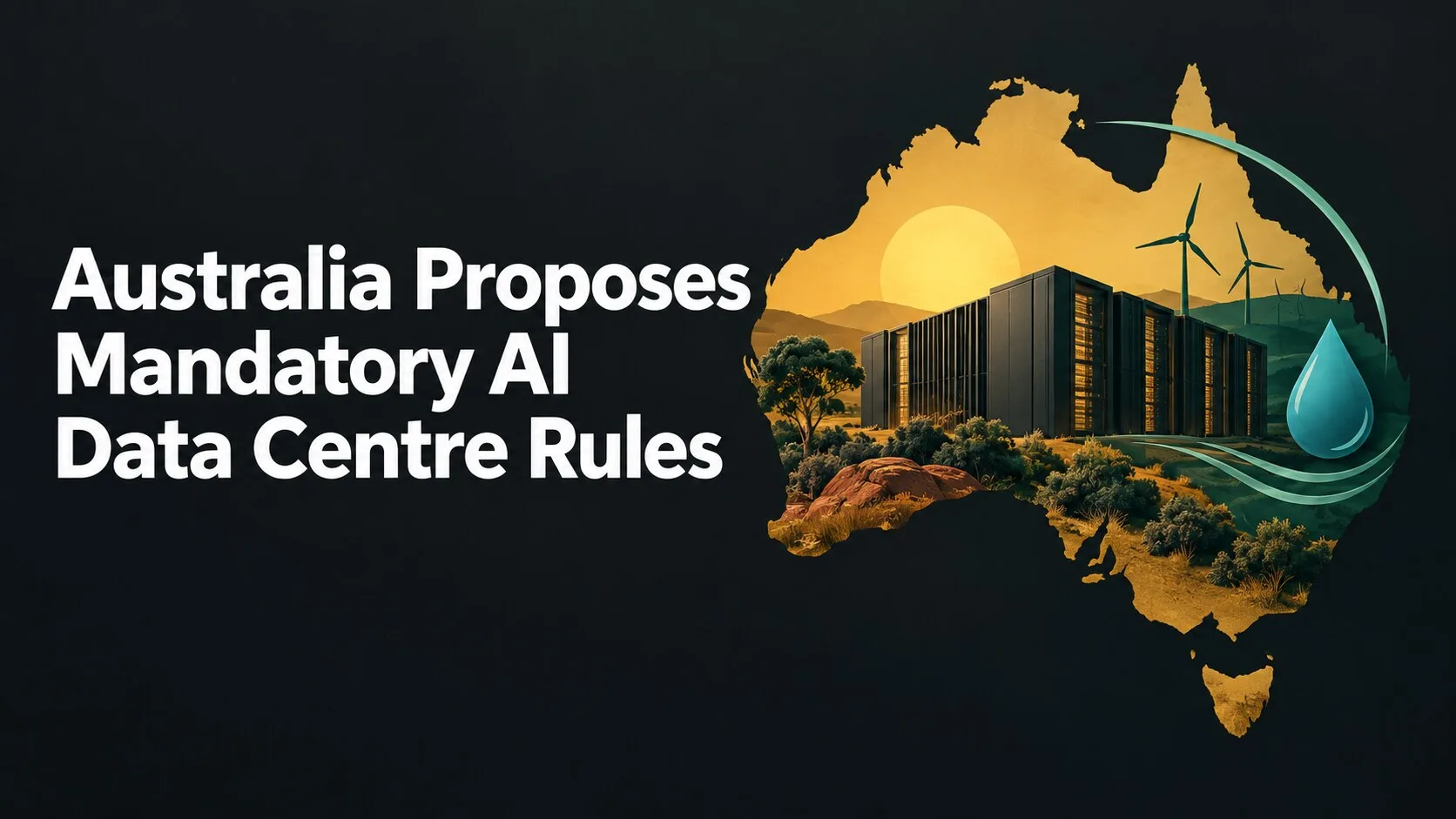
Australia proposes mandatory AI data centre rules covering energy, water, community costs and frontier-model training. The federal government opened consultation on a national standards framework that would apply baseline obligations to facilities between 30 and 100 megawatts, with stronger requirements above 100MW.
The consultation sets out four central infrastructure requirements:
- New renewable generation must fully offset covered facilities’ energy demand.
- Operators must minimise water use and report consumption transparently.
- Projects must avoid shifting network, utility or servicing costs to communities.
- Developers must engage councils, First Nations peoples and affected residents.
Australia Proposes Mandatory AI Data Centre Rules
The Department of the Prime Minister and Cabinet published the 28-page consultation paper, titled “Getting it right: Building AI infrastructure that works for Australia.” Submissions remain open until October 9, 2026, while the government conducts targeted discussions with industry and other stakeholders.
The framework would create nationally consistent minimum standards while preserving state and territory powers over planning, zoning, water allocation and most environmental approvals. Commonwealth legislation would add requirements for large data centres and separate conditions for companies training frontier AI models in Australia.
A proposed tiered system would exclude facilities below 30MW. Projects with an ultimate grid-connection capacity of 30MW to 100MW would face baseline duties, while sites of 100MW or more could receive stronger obligations. The government is also considering a 150MW cumulative threshold for portfolios of facilities.
Those boundaries are not final. The consultation asks whether capacity alone is sufficient or whether water use, computing performance and total electricity consumption should also determine which projects fall under the standards.
Renewable Power and Grid Costs
Covered data centres would be required to bring forward enough new renewable generation to fully offset their electricity demand. The proposed rules also call for firming capacity through gas, batteries or hydro, demand flexibility, and operating practices that protect grid reliability and consumer prices.
The paper says operators should bring their own energy resources and pay a fair share of network costs. That principle is designed to prevent rapid AI infrastructure growth from raising bills for households and businesses or forcing other users to fund new transmission and distribution assets.
The scale of the forecast explains the government’s focus. The Australian Energy Market Operator projects data-centre electricity use in the National Electricity Market could rise from about 5 terawatt-hours in 2025–26 to 34 TWh in 2035–36, increasing from roughly 3% to 13% of grid-supplied electricity.
Background Reading
Water Reporting and Location Controls
The mandatory standards would require operators to minimise water use, favour efficient cooling, and prioritise recycled or non-potable supplies. Facilities would also need resilience plans for drought and other disruptions, meet water-efficiency standards and disclose their consumption.
Australia’s data centres used an estimated 5.5 gigalitres of water for cooling in 2025, equal to about 0.04% of national industrial water use. The national share is small, but local pressure can be far greater where several campuses draw from the same catchment or municipal system.
Sydney Water estimates data centres could consume as much as 20% of the city’s drinking water by 2035. The paper also flags risks for regional communities and agricultural areas, including the Murray–Darling Basin, where new industrial demand could compete with irrigation and other established uses.
Location rules would address construction, traffic, noise and competition for land. Developers would need to keep projects away from sensitive community areas where impacts cannot be adequately managed, while consulting councils, local suppliers and First Nations communities during planning and assessment.
Frontier AI Training Conditions
The consultation goes beyond buildings and utilities. It proposes conditions for frontier AI training that connect access to Australian infrastructure with national security, safety, research, workforce development and the interests of creators, media companies and other rightsholders.
The government is considering which obligations should fall on facility owners, operators, tenants and AI developers. That distinction matters because a data-centre landlord may control power and cooling, while a model developer decides what is trained, which datasets are used and how computing capacity supports local research or skills.
Projects already moving through approval pipelines could also be captured before the standards take effect. The paper asks when developers should submit compliance plans, whether those plans should be public and how transition periods should work for facilities that begin operating before legislation is completed.
The proposal gives investors a clearer view of the direction of Australian policy, but important details remain open. Final thresholds, reporting frequency, enforcement arrangements and the allocation of duties across operators and AI companies will determine how demanding the framework becomes.