
Army Awards Palantir and Anduril $192 Million to Put AI-Powered TITAN Targeting Vehicles Into Production
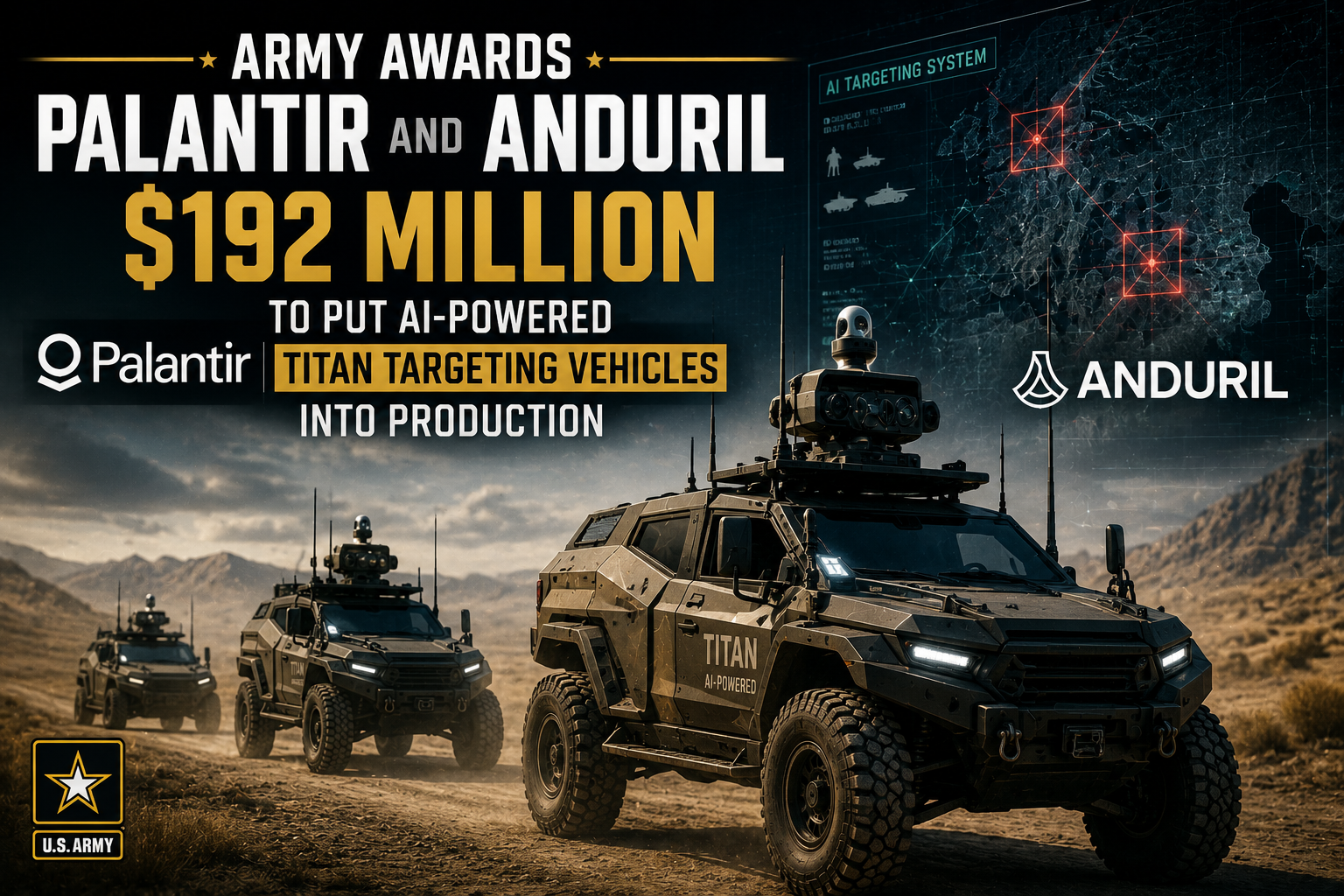
The U.S. Army has awarded Palantir Technologies and Anduril Industries a combined $192 million to begin full production of TITAN, an artificial-intelligence-powered mobile targeting system, marking the program's shift from battlefield prototype to fielded weapon system. The delivery order, announced this week, covers eight vehicles to be built and delivered over the next 18 months.
TITAN, short for Tactical Intelligence Targeting Access Node, is designed to solve one of the Army's longest-standing problems: turning a flood of raw sensor data into an actionable target in minutes rather than hours. The system pulls in feeds from satellites, drones, aircraft, and ground-based sensors, then uses AI to fuse that information and automatically nominate targets for long-range precision fires.
Army officials say the goal is to compress the "sensor-to-shooter" timeline so that units can find, track, and strike targets from much greater distances than current workflows allow.
Of the $192 million award, Palantir will receive $127 million as prime contractor, responsible for the AI software, systems integration, and sustaining the nine TITAN prototypes already fielded with soldiers since 2024.
Anduril will receive $65 million to manufacture the ruggedized, vehicle-mounted hardware and integrate the power, thermal, and control subsystems needed for the system to survive in the field. A supporting team of L3Harris Technologies, Sierra Nevada Corporation, Strategic Technology Consulting, and World Wide Technology rounds out the production effort.
The order calls for two configurations. An advanced variant, built on the Army's Family of Medium Tactical Vehicles, carries extra antennas and processing power to pull in data directly from space-based sensors. A basic variant is sized to fit on the Joint Light Tactical Vehicle and is built for mobility over the advanced model's added sensing range. The Army has also signaled interest in a third configuration mounted on the Infantry Squad Vehicle-Utility, suggesting TITAN's hardware footprint will keep evolving as the program matures.
This week's award is the latest milestone in a program that has already reshaped how the Army buys targeting technology. Palantir first won the right to build TITAN prototypes in 2024 with a $178.4 million contract, beating out defense incumbent RTX in a competition widely watched across the industry as a test of whether Silicon Valley-style software firms could out-compete traditional prime contractors on a core weapons program. Nine prototype units have been operating with soldiers at Joint Base Lewis-McChord since that award, giving the Army real-world performance data ahead of this week's production decision.
Army officials have been explicit about both the promise and the guardrails built into the system. Col. Jonathan Lipscomb said TITAN "drastically reduces sensor-to-shooter timelines through automated target nominations," while Maj.
Dell Barnes emphasized that the automation stops short of full autonomy: "There will always be a human on the loop within this workflow of target identification and nomination." Palantir USG president Akash Jain framed the production award as validation of an iterative, soldier-driven development process, saying TITAN "was shaped by the Soldiers who used it. That is the only way a system like this earns its place."
The contract lands at a moment when the Pentagon is leaning harder on AI-enabled sensor fusion and networked targeting as part of its broader Joint All-Domain Command and Control push, which aims to link sensors and shooters across the Army, Navy, Air Force, and Space Force into a single targeting web.
TITAN is one of the more mature pieces of that vision to reach production, and its success or failure will likely shape how quickly the Army commits to similar AI targeting programs across other vehicle classes.
The award also underscores a broader shift in defense procurement. Anduril and Palantir have spent the past several years positioning themselves as faster, cheaper alternatives to legacy defense contractors, winning a string of high-profile Army and Air Force programs by emphasizing commercial-style software development and rapid iteration over traditional multi-year defense acquisition cycles.
A production contract of this size, on a program that already beat out RTX for its initial award, adds to a growing list of proof points for that pitch — and gives both companies a template to point to as they compete for other modernization dollars.
For the AI industry more broadly, TITAN is a concrete example of autonomous sensor fusion and target recommendation moving from research demonstrations into operational military hardware, with a human still required to authorize any strike.
That human-in-the-loop design is likely to remain a focal point as the system scales: TITAN's automated targeting functions sit close to the center of ongoing debates in Washington and among arms-control advocates over how much decision-making authority should be delegated to AI in weapons systems, even when a person retains final approval.
The Army has indicated that additional TITAN production orders are expected in fiscal year 2027, alongside continued rapid prototyping to test new vehicle configurations and transport modes. With nine prototypes already in soldiers' hands and eight more advanced and basic units now under contract, TITAN is on track to become one of the largest fielded examples of AI-driven targeting technology in the U.S. military, and a bellwether for how far the Pentagon is willing to push automation into the kill chain.