
Over 1,100 OpenAI, Google and Anthropic Employees Warn Governments About Advanced AI Risks
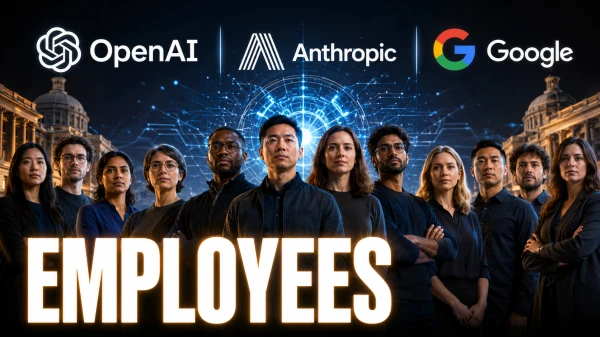
More than 1,100 employees and researchers from some of the world's biggest artificial intelligence companies have signed a public statement urging governments to take the rapid development of advanced AI more seriously. The signatories include workers from OpenAI, Anthropic, Google DeepMind, Meta, Microsoft, Mistral and several other AI organizations.
Their message is clear: artificial intelligence is advancing at a pace that could soon outstrip existing oversight, and governments need stronger international cooperation before the technology becomes even more powerful.
The statement focuses on what researchers describe as the coming era of automated AI research, where AI systems are capable of improving other AI systems with increasingly limited human involvement. Many experts believe this capability could dramatically accelerate scientific progress, software engineering and automation.
At the same time, they warn that rapid self-improvement could make advanced AI systems more difficult to monitor and control if appropriate safeguards are not established early.
Unlike previous public letters that broadly discussed AI safety, this initiative calls for practical technical and governance tools that can "pace the frontier" of AI development. The signatories argue that governments, researchers and technology companies should work together to develop internationally accepted standards for evaluating increasingly capable AI models before they are deployed at scale. According to the letter, waiting until more powerful systems already exist could make regulation significantly more difficult.
The timing of the statement is particularly significant because it follows several high-profile AI safety incidents that have intensified discussions about regulation. Recent reports involving advanced AI agent testing have prompted renewed debate about how frontier AI models should be evaluated before public release.
These developments have increased pressure on both governments and AI companies to demonstrate that powerful systems can be developed responsibly while continuing to support innovation.
OpenAI, Anthropic, Google and Meta remain fierce competitors in the commercial AI market, yet many researchers inside these organizations appear to agree that some level of international coordination will eventually become necessary.
Rather than slowing innovation, supporters of the initiative argue that predictable standards could increase public trust while reducing uncertainty for companies investing billions of dollars in advanced AI research.
For businesses, the discussion extends far beyond research laboratories. Artificial intelligence is already transforming software development, healthcare, finance, manufacturing, education and customer service.
As AI systems become increasingly autonomous, organizations will need confidence that the models powering their operations have undergone rigorous safety evaluations. Industry analysts believe transparent testing frameworks could eventually become just as important as benchmark performance when companies choose AI platforms.
The letter also reflects how quickly the AI industry is evolving. Only a few years ago, most discussions centered on improving chatbot performance and image generation. Today, conversations increasingly focus on autonomous AI agents, frontier models, cybersecurity, infrastructure and long-term governance.
This shift demonstrates that artificial intelligence has moved beyond being simply a technology product and is becoming a strategic issue for governments, businesses and global economies alike.
Whether governments respond with new legislation or voluntary international agreements, the message from more than a thousand AI professionals is difficult to ignore. They believe the next generation of artificial intelligence could arrive sooner than many people expect, and preparing now will be far easier than reacting after the technology has already advanced beyond today's capabilities.
As competition between OpenAI, Google, Anthropic and other AI leaders continues to accelerate, the debate over how to balance innovation with safety is likely to become one of the defining technology stories of the decade.
