
Nvidia Warns Hyperscalers of Over 15% AI Server Price Hikes on Rubin and Blackwell Systems
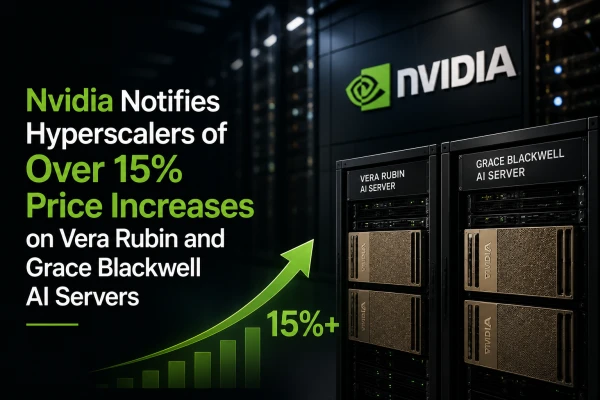
Nvidia’s largest cloud and data-center customers have been notified that the prices of servers built around its artificial-intelligence chips will rise by more than 15 percent in many cases beginning with shipments early next year.
The increases will apply to systems using the company’s flagship Vera Rubin and Grace Blackwell processors and will vary according to chip generation and memory configuration, according to people familiar with the communications who spoke to Bloomberg.
Contract manufacturers that assemble the servers for operators including Microsoft, Google and Oracle have passed the higher prices on to those customers. Nvidia did not respond to requests for comment.
The driver is a sharp rise in the cost of high-bandwidth memory and related DRAM that has outpaced even the aggressive production ramp by the three dominant suppliers—Samsung Electronics, SK hynix and Micron Technology.
AI accelerators consume large quantities of this specialized memory; without it the chips cannot deliver the bandwidth required for training and inference at scale. Demand from the continuing hyperscaler build-out has kept the market tight even as overall output has increased.
The timing is significant. Many large operators and national AI infrastructure projects have been budgeting on the basis of 2025 and early-2026 hardware price levels.
A sustained 15 percent-plus uplift on the most advanced rack-scale systems—already among the most expensive pieces of capital equipment in the industry—will raise the total cost of ownership for new clusters and could force adjustments to capacity plans or financing arrangements.
Nvidia itself continues to report gross margins near 75 percent and remains the most valuable publicly listed company in the world, yet it is not absorbing the full increase in memory costs.
That decision underscores the leverage now held by the memory makers. Industry observers note that the same tightness is visible in other parts of the server bill of materials, including power-delivery components and advanced packaging, but memory has emerged as the clearest short-term pressure point.
For hyperscalers the higher server prices arrive at a moment when power availability, grid interconnection queues and local community opposition to new data centers are already constraining growth.
Adding a material step-up in hardware cost compounds those constraints. European AI “gigafactory” projects that have secured public funding on the basis of earlier cost assumptions may also need to revisit their capital plans.
The notifications cover both the current-generation Grace Blackwell systems still shipping in volume and the forthcoming Vera Rubin platforms that Nvidia has positioned as the next major architecture.
Earlier analyst estimates had already projected substantial increases in the cost of Rubin-based racks driven by higher HBM4 content; the formal customer notices confirm that those higher costs are being passed through rather than internalized by Nvidia or its contract manufacturers.
Market reaction will be watched closely when Nvidia reports its next quarterly results. Investors have treated the company as a pure-play proxy for AI infrastructure demand. Any signal that customers are delaying or resizing orders in response to the higher prices could temper the aggressive growth narrative that has supported the stock.
Conversely, if hyperscalers simply accept the increases as the price of staying competitive, the episode will reinforce the view that demand remains price-inelastic at the frontier.
The broader context is a multi-year AI infrastructure cycle that has already driven record capital expenditure among the largest cloud providers and a parallel wave of investment in power generation, cooling and networking.
Memory has become one of the few components whose supply curve has not kept pace with that demand. Until additional capacity comes online or alternative memory architectures mature, price pressure of this kind is likely to remain a recurring feature of AI hardware economics.
In the near term, operators will be forced to choose among three imperfect options: absorb the higher costs and protect capacity growth, slow the pace of deployment, or accelerate efforts to diversify their accelerator mix and reduce dependence on any single supplier’s pricing. None of those choices is costless. The notifications that went out this week simply make the trade-offs more explicit.