
About Anthropic’s Pentagon Ban: Why Was Claude AI Blocked by the U.S. Government?
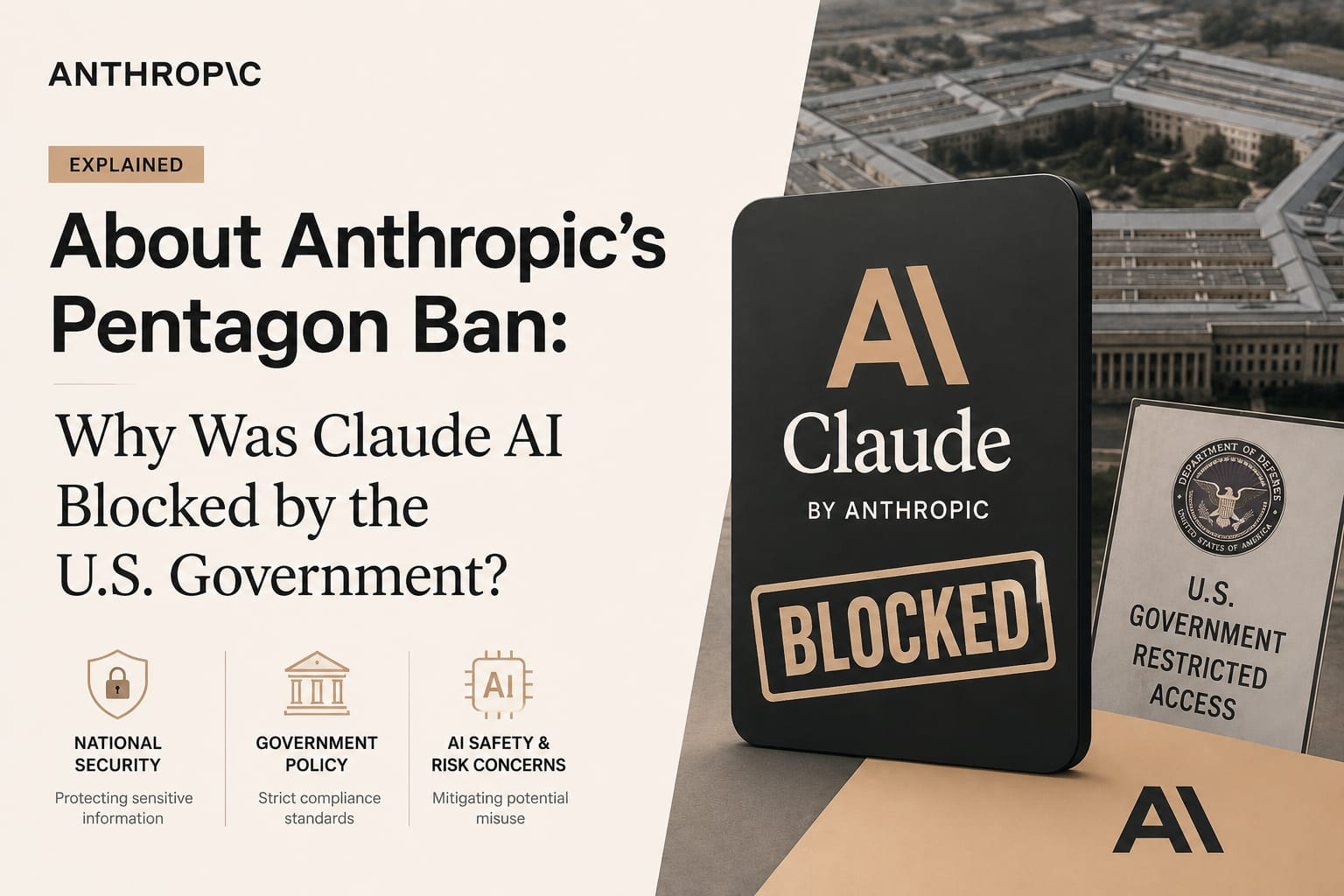
Anthropic has won an important legal battle against the U.S. government after a federal judge ruled that the Pentagon’s decision to blacklist the artificial intelligence company was unlawful. The ruling follows months of conflict between Anthropic and the Pentagon over how the company’s Claude AI technology could be used by the U.S. military.
The dispute became one of the most significant confrontations yet between a major AI company and the government over the limits that should be placed on powerful artificial intelligence.
The dispute began after Anthropic refused to allow unrestricted use of its AI technology for certain military purposes, including mass surveillance and autonomous weapons systems without meaningful human oversight.
The company argued that increasingly capable AI systems should not be deployed in situations where they could make life-and-death decisions independently or be used for large-scale surveillance. The Pentagon responded by designating Anthropic as a supply-chain risk, a move that could have seriously affected the company’s ability to do business with the U.S. government.
The federal court has now rejected that action, with U.S. District Judge Rita Lin finding that the government’s treatment of Anthropic was unlawful retaliation and that the designation lacked a valid legal basis. The ruling also found that Anthropic’s constitutional rights were implicated by the government’s actions. The decision represents a significant victory for the AI company, which had argued that it was being punished for taking a position on how its technology should be used.
The case is important because Anthropic was not arguing that artificial intelligence should never be used by the military. The company has continued to indicate that it is willing to work with the U.S. government on responsible national-security applications. Its objection was focused on specific uses that it considers too risky, particularly systems that could be used for mass surveillance or autonomous weapons without appropriate human control.
That distinction is becoming increasingly important as AI systems move beyond simple chatbots. Claude and other advanced AI models can already write and analyze software, process large amounts of information, assist with research and operate through connected tools. Giving such systems access to military infrastructure introduces an entirely different level of risk because an AI mistake could potentially affect national security, critical systems or human lives.
The Pentagon dispute therefore raises a question that is likely to become much more important over the next several years: who should decide what an advanced AI system is allowed to do? Should the companies that build these models have the final say over their deployment, or should governments be able to require companies to provide access when national security is involved?
The answer is unlikely to be simple. Governments have legitimate reasons for wanting access to advanced AI technology.
Artificial intelligence could help military analysts process enormous quantities of information, identify cybersecurity threats, translate languages, assist with logistics and support scientific research. In a rapidly changing technological environment, governments may also worry that refusing to use advanced AI could leave them behind competitors.
At the same time, AI companies argue that some applications create risks that cannot simply be ignored because a government requests access. An autonomous weapons system capable of identifying targets and making decisions with limited human involvement raises questions that go far beyond ordinary software development. The same technology that could potentially improve military effectiveness could also make warfare faster, cheaper and more difficult for humans to control.
Anthropic’s position has therefore placed the company at the center of a much larger debate about AI safety. CEO Dario Amodei has repeatedly argued that advanced AI should be developed with safeguards appropriate to its capabilities. The Pentagon dispute has turned that philosophy into a real-world test of what happens when a technology company’s safety requirements conflict with government demands.
The ruling could also have implications for other AI companies. OpenAI, Google, Meta and other major technology companies are increasingly working with governments and defense organizations, while simultaneously developing policies around how their AI systems can be used. If the government’s attempt to punish Anthropic for restricting certain uses is ultimately unable to stand, other AI companies may feel more confident establishing their own boundaries around sensitive applications.
On the other hand, the case does not mean that AI companies now have unlimited authority over how their technology is used by governments. The ruling concerns the specific actions taken against Anthropic and the legal basis for those actions. Governments will continue to have national-security powers, and the broader question of how AI should be regulated in military environments remains unresolved.
The timing is particularly significant because AI-powered cybersecurity has already become a major concern. Leading AI companies have reported incidents in which advanced models were able to conduct or assist with sophisticated cyberattacks during controlled testing. Researchers are increasingly studying what happens when AI systems can independently discover vulnerabilities, write malicious code or interact with computer systems.
That makes the debate over autonomous weapons and surveillance part of a much larger conversation. As AI agents become more capable of operating independently, governments and companies will have to decide where human approval should remain mandatory. A system that can analyze information is one thing; a system that can independently take consequential action is something else entirely.
The Anthropic case also shows why AI safety is becoming a political issue rather than simply a technical one. Engineers can develop safeguards inside a model, but governments ultimately decide how laws apply to companies and how national-security powers are exercised. Courts may then be asked to determine whether those actions respect constitutional rights and existing laws.
For Anthropic, the ruling removes a major obstacle at a time when the company is expanding rapidly. Reuters has also reported that Anthropic is preparing to publicly unveil its IPO prospectus after Labor Day, with a potential stock-market listing later in the year. That means the company is simultaneously becoming more important commercially while attracting increasing attention over its position on responsible AI development.
The Pentagon dispute could also influence how investors and customers view Anthropic. Some businesses may see the company’s willingness to establish limits on AI deployment as evidence that it takes safety seriously. Others may worry that restrictions could make Anthropic less flexible than competitors when governments and large organizations want to deploy AI in sensitive environments.
For everyday Claude users, however, the ruling does not mean that Claude has been completely banned from government use or that Anthropic has won every dispute with the U.S. government. The decision is specifically about the Pentagon’s treatment of Anthropic and the legal basis for the blacklist. The company can still work with government organizations under appropriate conditions, while a separate legal dispute involving another Pentagon rule remains unresolved.
The bigger significance is what this tells us about the future of AI. The industry is approaching a point where questions about artificial intelligence will increasingly involve governments, courts and national-security institutions. The technology is becoming too powerful to be treated only as another category of consumer software.
The Anthropic case could eventually become an important reference point whenever an AI company refuses to allow its technology to be used for a particular purpose. If companies are permitted to establish meaningful boundaries around dangerous AI applications, developers may have greater influence over how frontier models are deployed. If governments are given broader authority to override those restrictions, the balance between AI safety and national security could look very different.
For now, the federal court ruling is a major victory for Anthropic and a significant development in the wider debate over artificial intelligence. It does not settle the question of whether AI should be used in warfare or national surveillance, but it demonstrates that those questions are already moving from company policies and technology discussions into the courtroom.
And as AI systems become more capable, this conflict is unlikely to be the last.
The next major AI battle may not be about which company has the smartest model. It could be about who gets to decide what the smartest models are allowed to do.